First-time buyers are compromising as affordability tightens
First-time buyers are trimming their wish lists. Before a lender says yes, it checks four things, and one of them tests you at a rate you will never pay.*
In Calgary, first-time buyers say they are willing to compromise (Yahoo News, 29 Oct 2026) and elsewhere, lower affordability is narrowing their choices. The reasons are not mysterious. Here is the backdrop, and then the rules that decide how much a lender will let you borrow.
What is the backdrop?
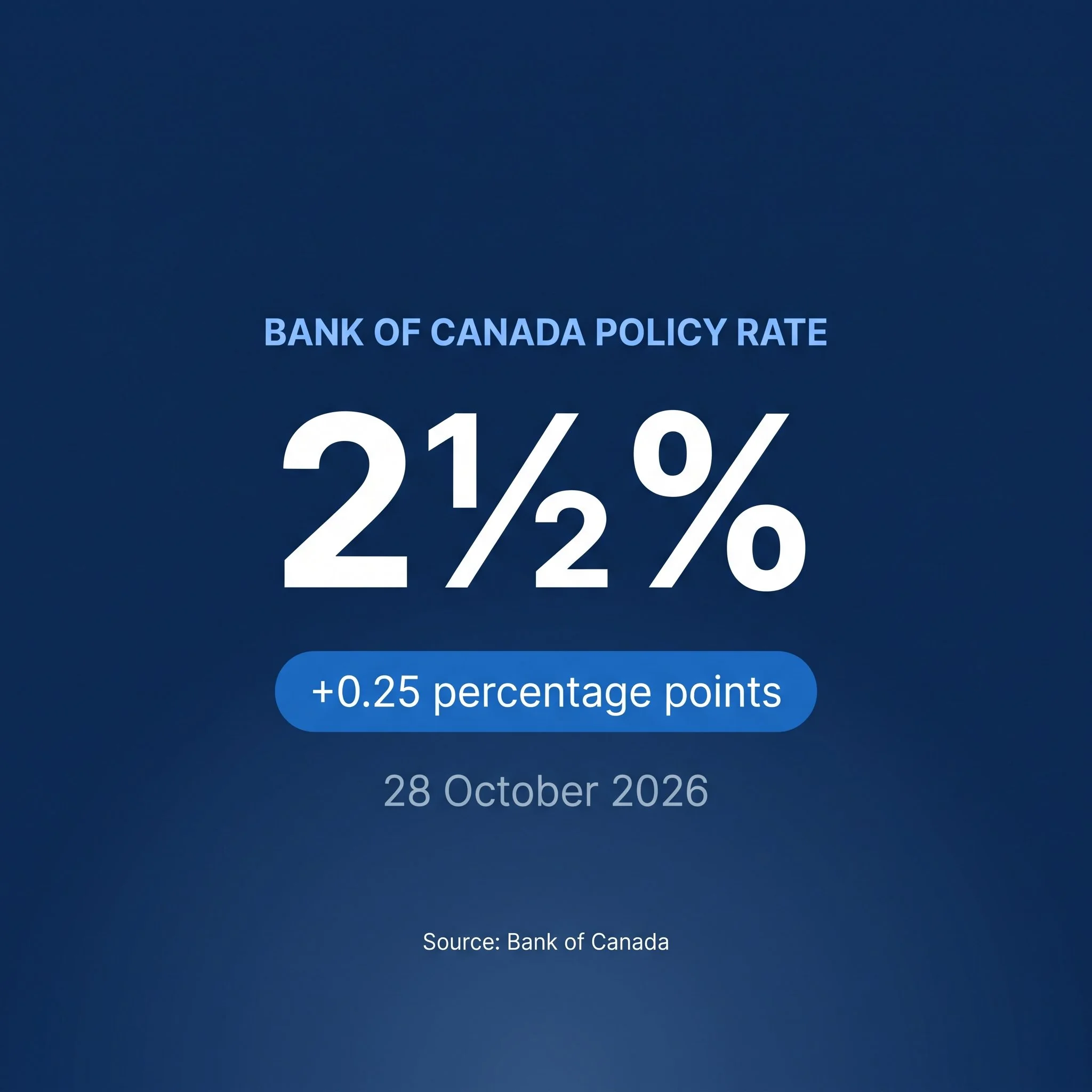
The Bank of Canada raised its policy rate by 0.25% to 2½% on October 28th.
Toronto and Vancouver housing bubble risk has eased, according to a UBS index, largely due to falling prices (Wealth Professional, 25 Sep 2026).
CMHC says Canada has an extreme housing shortage and needs up to 4.69 million new homes by 2036, though construction could slow (BNN Bloomberg, 10 Sep 2026). That means there is plenty of pent-up demand, if we can deliver housing that people can afford.
Easing risk does not mean easy buying. Prices may be softer in places, but a higher rate reduces what a given income can borrow. That is why affordability stays tight even when prices fall.
How do lenders decide how much you can borrow?

Income and debts. For an insured mortgage, housing costs can be up to 39% and total debts up to 44% of gross income, tested at the qualifying rate (CMHC).
Down payment. The minimum is 5% of the first $500,000 of the price and 10% of the rest, for homes up to $1.5 million. At $1.5 million and above, you need 20% down (Financial Consumer Agency of Canada, page dated 15 Oct 2025). Put down less than 20% and you typically must buy mortgage default insurance. The CMHC premium is 4.00%, 3.10% or 2.80% of the loan, depending on your down payment (CMHC). Insurance also has a maximum purchase price, so ask your lender whether it applies to the home you want.
The stress test. For an uninsured mortgage, lenders must test you at your contract rate plus 2%, or 5.25%, whichever is higher (OSFI, page modified 29 Jan 2026). Your lender checks you against that higher rate, not the one you will actually pay.
Other costs. Property tax, heat, condo fees and closing costs all take a share of the same income.
What does the stress test look like in dollars?
Take a $500,000 mortgage with a 25-year amortization. The typical 5-year fixed rate across lenders was 4.80% in the week of 30 October 2026 (Properti Edge analysis of CANNEX data). At 4.80%, the payment is about $2,851 a month. Add the 2% test buffer and the lender tests you at 6.80%, where the payment is about $3,441. That is about $590 a month more. You pay the first number. The lender checks that you could pay the second.
That gap is what limits the size of the loan, and it is the part of the process that surprises people most.
What does the down payment look like in dollars?
On an $800,000 home, the minimum down payment is $55,000: 5% of the first $500,000 ($25,000) plus 10% of the remaining $300,000 ($30,000). That is 6.9% of the price. A buyer who puts less than 20% down pays insurance on the loan of $745,000. At a 4.00% premium, that is $29,800, which is added to the mortgage and takes it to $774,800. At 4.80% over 25 years, that payment is about $4,418 a month, before property tax, heat or condo fees.
Both examples are illustrations, not quotes. They assume semi-annual compounding, which is how fixed rates are quoted in Canada, and your lender's numbers will differ.
Lenders are not asking what you pay today. They are asking what you could pay if your rate were 2% higher.
From Properti Edge
Put your own numbers through the test
Ask the Properti Edge AI Advisor to explain the stress test, or enter your income, debts and down payment in Buying Power to see a borrowing range. The Advisor answers like this:
The mortgage stress test is a federal rule that requires lenders to ensure you can still afford your monthly payments if interest rates rise in the future. Instead of using the actual interest rate on your contract to see if you qualify, lenders must test your finances using a higher "all-in" qualifying rate. This serves as a financial safeguard to prevent you from overextending yourself if your costs increase at renewal time.
Answer given November 5th, 2026. Shortened here to the opening paragraph.
A range is not an approval. Your lender makes that call. General information, not advice.
Rule values: FCAC (15 Oct 2025), OSFI (29 Jan 2026), CMHC cost page; the income limits and premium bands were also checked by the Properti Edge product owner on 2 Nov 2026.
This is general information, not advice. Speak to a mortgage broker, real estate agent or real estate lawyer, depending on your situation, before acting.