
Rates just rose. What it can cost to break a mortgage in Canada
October was a bad month to be nervous about your mortgage. On 28 October the Bank of Canada raised its policy rate by 0.25% basis points to 2½%. Earlier in the month, CIBC and TD raised fixed mortgage rates by 0.20%, which completed a sweep of the Big Six banks. And CBC reports that B.C. households are feeling the squeeze as pandemic-era mortgages come up for renewal.
So the question landing in a lot of inboxes is simple. Can I break my mortgage, and what will it cost?
We have a longer explainer on this: Penalties for Early Mortgage Repayment
Here is the short version, and what has changed this month.
Open or closed: does the penalty apply to you?
An open mortgage lets you repay any amount at any time with no penalty, and usually carries a higher rate. A closed mortgage commits you to a term, and most closed contracts let you repay a set share of the original amount each year without a penalty. Our explainer puts that at 15% to 20%. FCAC says the amount varies by lender, and unused room usually cannot be carried forward. Pay off more than your limit and a penalty applies.
How does a mortgage penalty work?
The Financial Consumer Agency of Canada (FCAC) says the penalty on a closed mortgage will usually be the higher of two amounts: three months of interest on what you still owe, or the “interest rate differential” (IRD). Your contract sets out which method applies.
Three months of interest
This is the simpler one. Take a $400,000 mortgage at 5.00%, compounded semi-annually, which is how fixed rates are quoted in Canada. Converted to a simple annual rate, that is about 5.06%. So a year of interest is about $20,250, and three months of it is about $5,063. That is from our explainer's worked example, not a quote. Some lenders use the plain contract rate, which gives $5,000 here, so ask which they use.
The interest rate differential (IRD)
The IRD applies only to fixed rate mortgages, and it is the harder one. In plain terms, the lender compares your rate with the rate it could charge today for a term close to the time you have left. FCAC says lenders usually use the IRD when your rate is above the current rate and your contract was signed less than five years ago.
The catch is that lenders do not all calculate it the same way. Our explainer walks through three methods:
Standard IRD: your contract rate against the lender's current posted rate.
Discounted IRD: your contract rate against the current posted rate minus the discount you negotiated.
Posted IRD: the original posted rate against the current posted rate, ignoring your discount.
Most of the seven largest Canadian banks use the discounted method. In our worked example (a 5% contract rate, a 6% posted rate, four years left and a 4% posted rate today), the gap is one percentage point under the standard method and two under the discounted and posted methods. The penalty roughly doubles on the same mortgage, depending on the lender's method. FCAC also says some lenders compare against posted rates rather than the discounted rate you actually got, which can make the penalty bigger.
FCAC gives its own example. On a $200,000 balance at 6% with 36 months left and a current posted rate of 4%:
three months of interest is $3,000 and;
the IRD is $12,000,
So the penalty is $12,000, plus possibly an administration fee. That is FCAC's illustration, not a quote for anyone.
What about a variable rate mortgage?
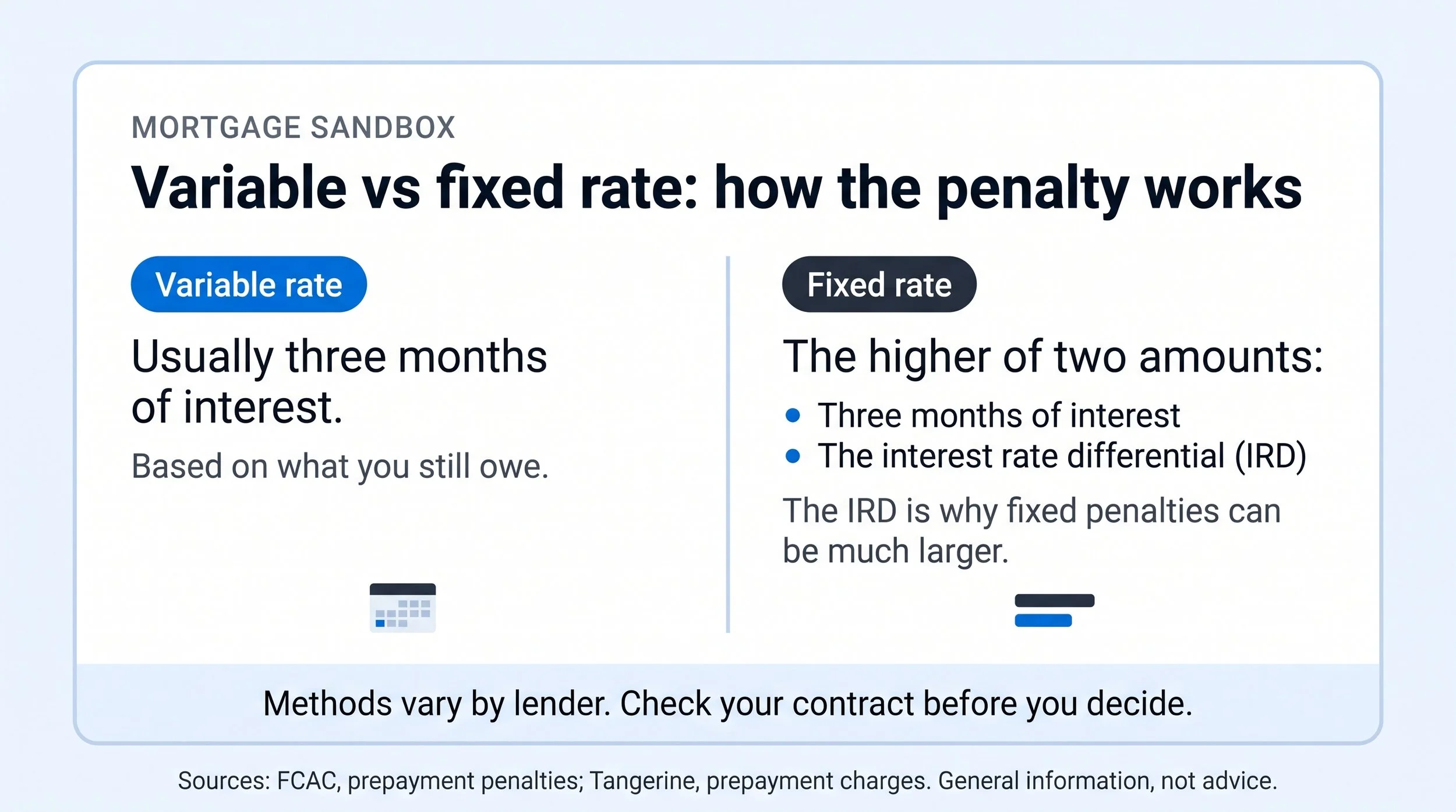
Variable rate mortgages usually work differently. Because the IRD applies only to fixed rate mortgages, the charge on a variable rate mortgage is generally three months of interest. Tangerine, for one, states that the charge on its variable rate mortgages is equal to three months of interest ([Tangerine, prepayment charges](https://tangerine.ca/en/faq/how-do-prepayment-charges-differ-between-a-fixed-and-variable-mortgage)). The IRD is the part that makes fixed rate penalties so much larger, so a variable penalty is usually the smaller of the two. Check your contract, because FCAC says the method varies from lender to lender.
Here is where the Bank of Canada comes in. A variable rate moves with the lender's prime rate, and prime follows the policy rate. When the Bank raised its rate by 0.25 percentage points on 28 October, variable rates rose with it, and three months of interest on the same balance rose too. The effect is small. On a $500,000 balance, 0.25 percentage points is about $313 more over three months (0.0025 x $500,000 / 4). That is an illustration, not a quote. Your lender's contract decides which rate the three months of interest is based on.
Are there ways to avoid or reduce the penalty?
Wait for the end of your term. Prepaying then carries no penalty.
Use your prepayment privileges first. Our explainer's strategy is to make your full allowable prepayment 15 to 30 days before the final payoff, which lowers the balance the penalty is charged on. You have to fund it from savings or a line of credit, so weigh the cost of borrowing.
Ask about blend-and-extend. Some lenders blend your old rate with the new term's rate, with no prepayment penalty, though administrative fees may apply.
FCAC, breaking your mortgage contractMoving house? Ask whether you can “port” your rate and terms to the new home. Port referst to a portability feature that some banks offer on their mortgages. Not all banks offer this option and you will likley need to re-qualify for the mortgage.
The penalty is not the only cost. Discharge, transfer, reinvestment and early renewal fees can apply too, and they vary by lender. Some are charged whether or not you break your contract, so ask for the full list in writing.
Does a rate hike change the penalty?
On a variable rate mortgage the effect is direct and small, as above: a higher rate means slightly more interest in the three-month calculation. On a fixed rate mortgage, FCAC does not say how a rate rise affects the IRD. The arithmetic suggests that when today's rates rise toward yours, the gap narrows and so does the IRD, but treat that as a reasoning step, not a rule, and ask your lender. Breaking a low-rate mortgage to take a higher one can cost you far more in interest over the new term than you save on the penalty. Only your own numbers show which way it falls.
What should you ask your lender?
How do you calculate my penalty: three months of interest or the IRD, and based on which rates (my contract rate or your prime or posted rate)?
How much can I prepay each year without a penalty?
Can I blend and extend, or port my rate?
Will a new loan amount or longer amortization trigger a new mortgage insurance premium? FCAC says it can when the loan grows or you extend the amortization.
FCAC, renewing your mortgage
Get the answers in writing. A verbal estimate is not a quote.
From Properti Edge
Know what to ask before you call your lender
Penalty terms are easy to get lost in. Ask the Properti Edge AI Advisor to explain words like interest rate differential, prepayment privilege and porting in plain language, so you know the questions to put to your lender.
Properti Edge does not calculate your penalty. Your lender does. General information, not advice.
Note: This is general information, not advice. Speak to a mortgage broker or lender, depending on your situation, before acting.