Buying Toronto Real Estate: Is Now the Time, or Should You Wait Until Winter?
A data-driven analysis of Greater Toronto's balanced market, shifting interest rate dynamics, and why winter could present strategic opportunities for buyers.
Prospective home buyers across Metro Toronto are evaluating whether to re-enter the market or remain on the sidelines. While prices have continued to soften across all housing categories over the past quarter, inventory levels have tightened compared to last year. Metro Toronto currently operates as a balanced market, though subtle shifts are trending in favour of sellers as active listings drop faster than demand. With borrowing rates having likely reached their floor for this cycle and bond yield pressures building, navigating today's market requires balancing current price concessions against future rate expectations.
Metro Toronto Key Market Metrics Breakdown
| Segment | Market Status | Months of Supply | Benchmark Price | YoY Price Trend |
|---|---|---|---|---|
| Detached Houses | Balanced Market Trending to Seller | 4.7 Mo. Down 10% from 5.2 | $1,209,600 | -4% from $1,264,200 |
| Condo Apartments | Balanced Market Trending to Seller | 5.9 Mo. Down 12% from 6.7 | $531,200 | -7% from $571,500 |
| Townhouses | Balanced Market Trending to Seller | 5.1 Mo. Down 7% from 5.5 | $666,500 | -7% from $715,100 |
Metro Toronto Detached House Market Conditions
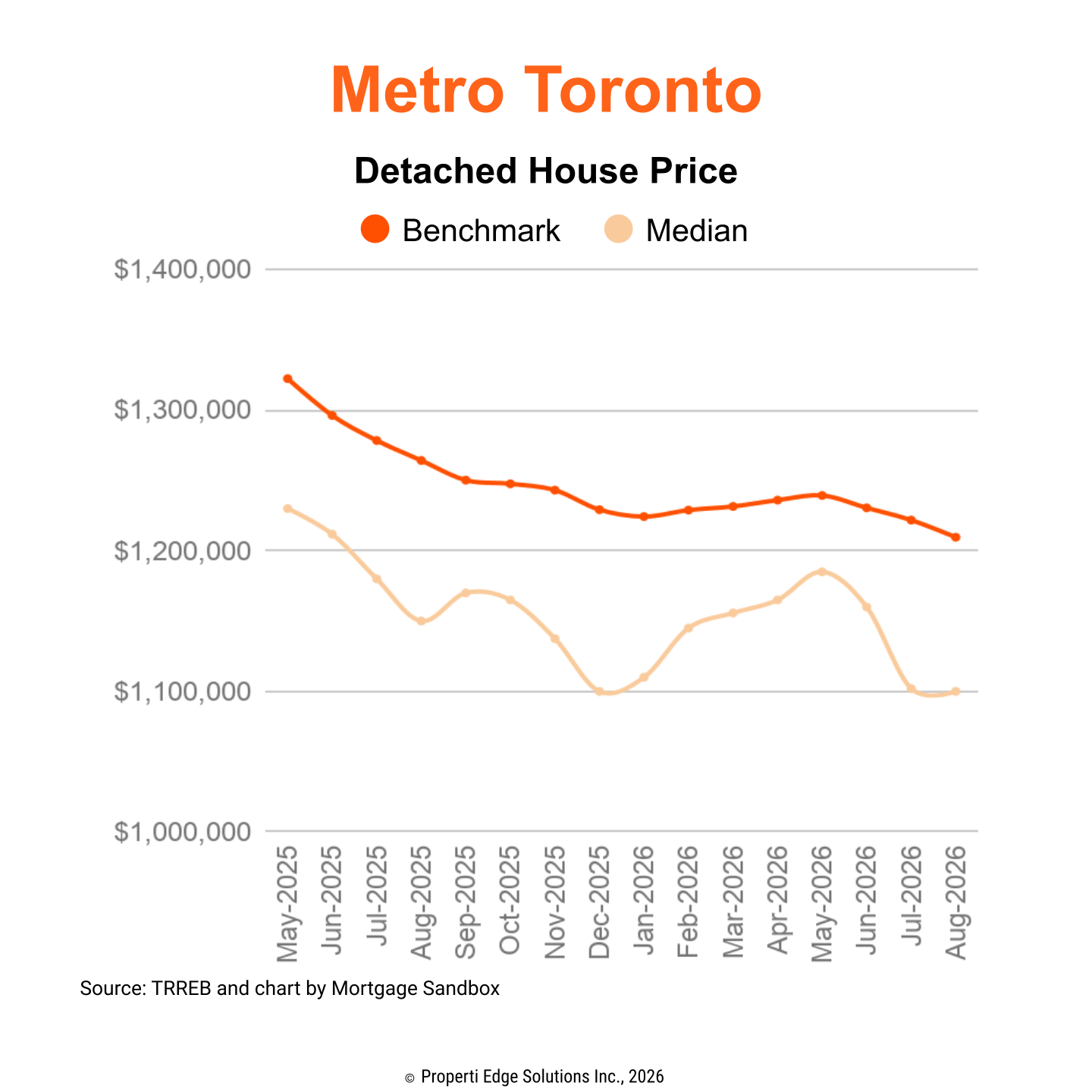
The detached house segment operates as a balanced market where buyers and sellers hold comparable negotiating strength. Inventory levels have tightened over the past year, dropping from 5.2 to 4.7 months of supply (a 10 per cent reduction), gradually reducing buyer selection.
Demand & Supply: Purchase demand remained flat (0 per cent change), while the active supply of listings declined by 9 per cent.
Price Movement: The benchmark detached price sits at $1,209,600, representing a 2 per cent decline over the past three months and a 4 per cent drop year-over-year from $1,264,200. The median detached price stands at $1,100,000, down 7 per cent over the past three months.
Metro Toronto Condo Apartment Market Conditions
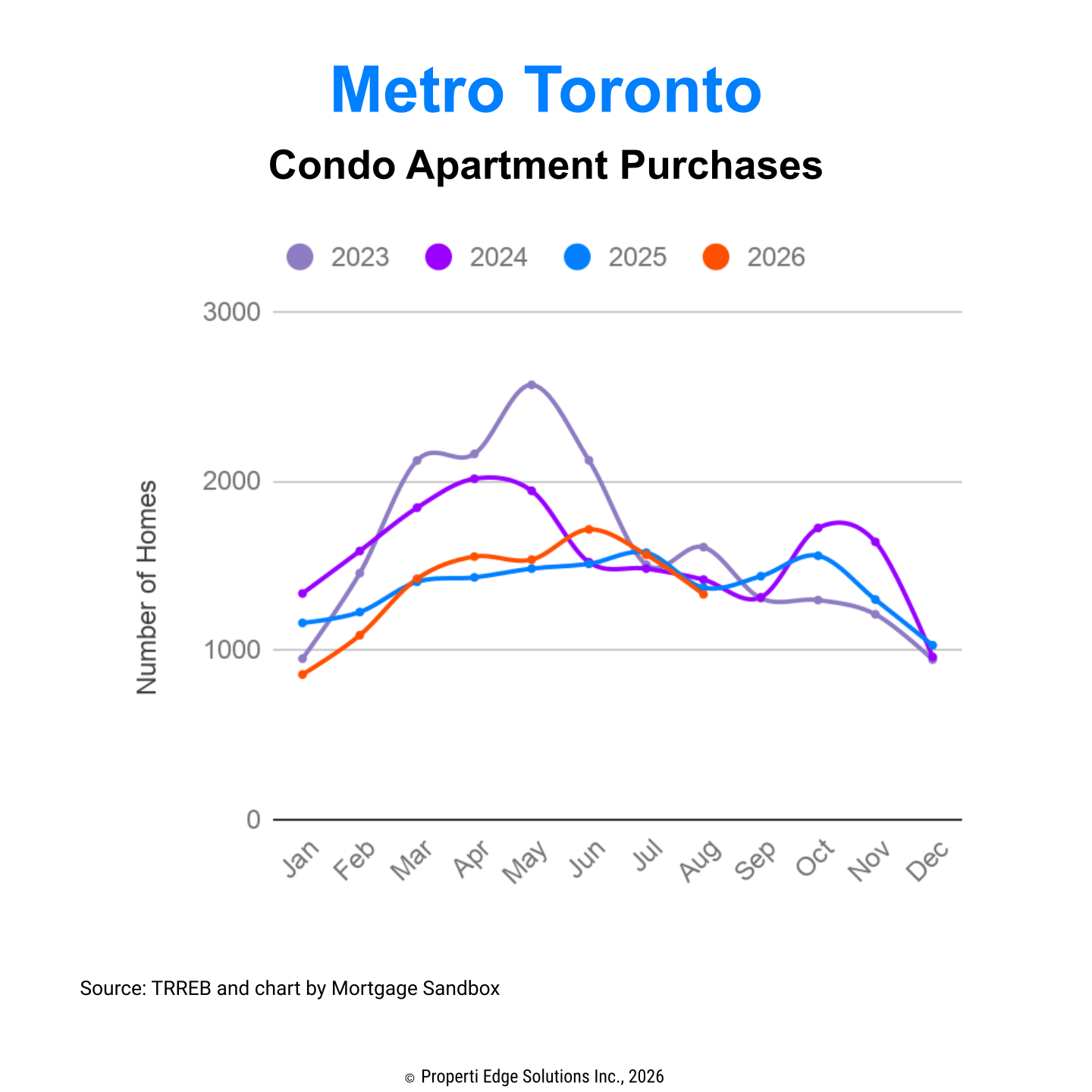
Toronto's condo market remains balanced, though active inventory has contracted noticeably. Months of supply fell by 12 per cent year-over-year, dropping from 6.7 to 5.9 months. Persistent investor apathy and broader supply overhangs in major Canadian urban centres continue to exert downward pressure on prices, a trend that could extend into 2027.
Demand & Supply: Purchase demand fell 3 per cent, while active listings contracted by 13 per cent.
Price Movement: The benchmark condo apartment price stands at $531,200, down 2 per cent over the last three months and 7 per cent year-over-year from $571,500. The median condo price is $530,000, reflecting a 3 per cent quarterly decline.
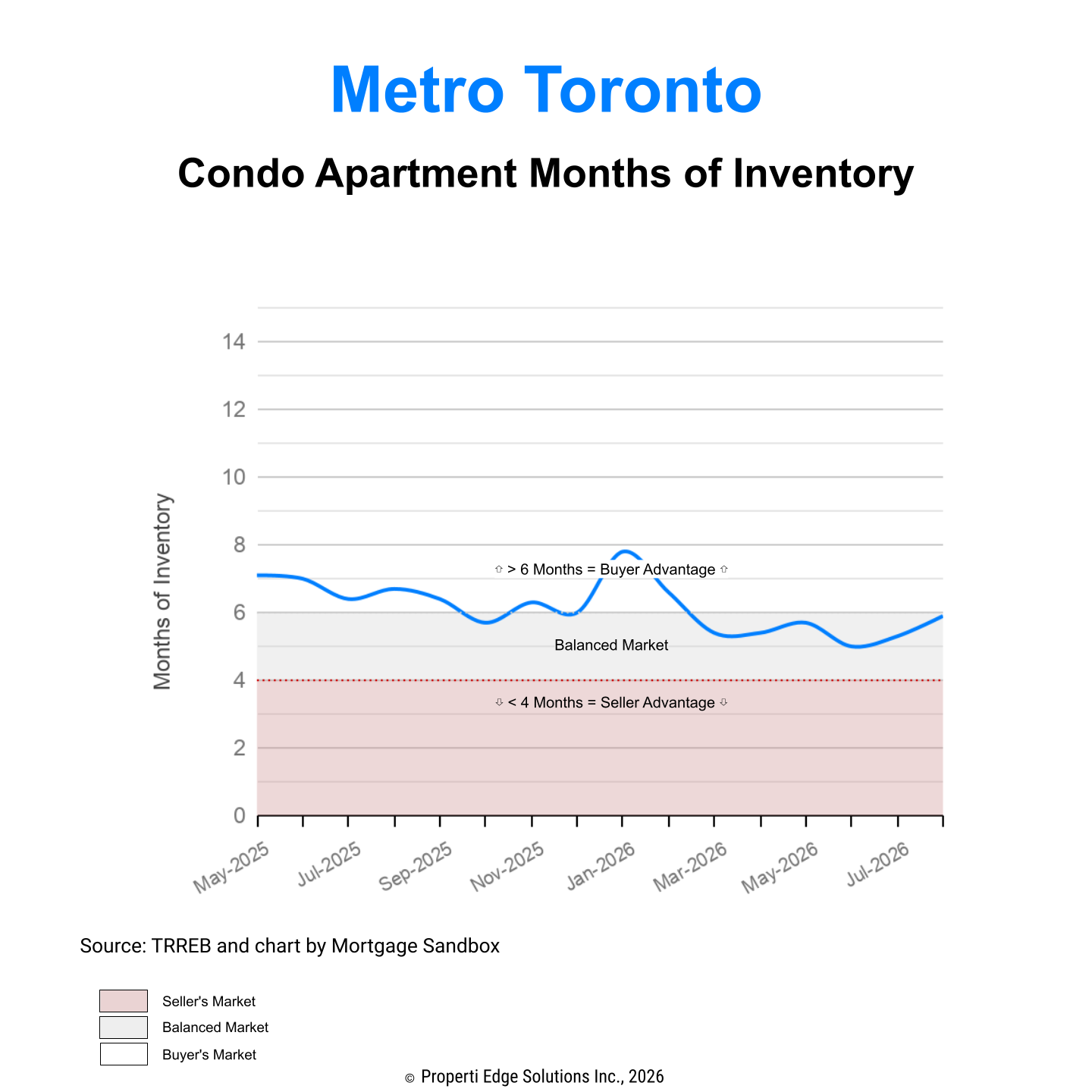
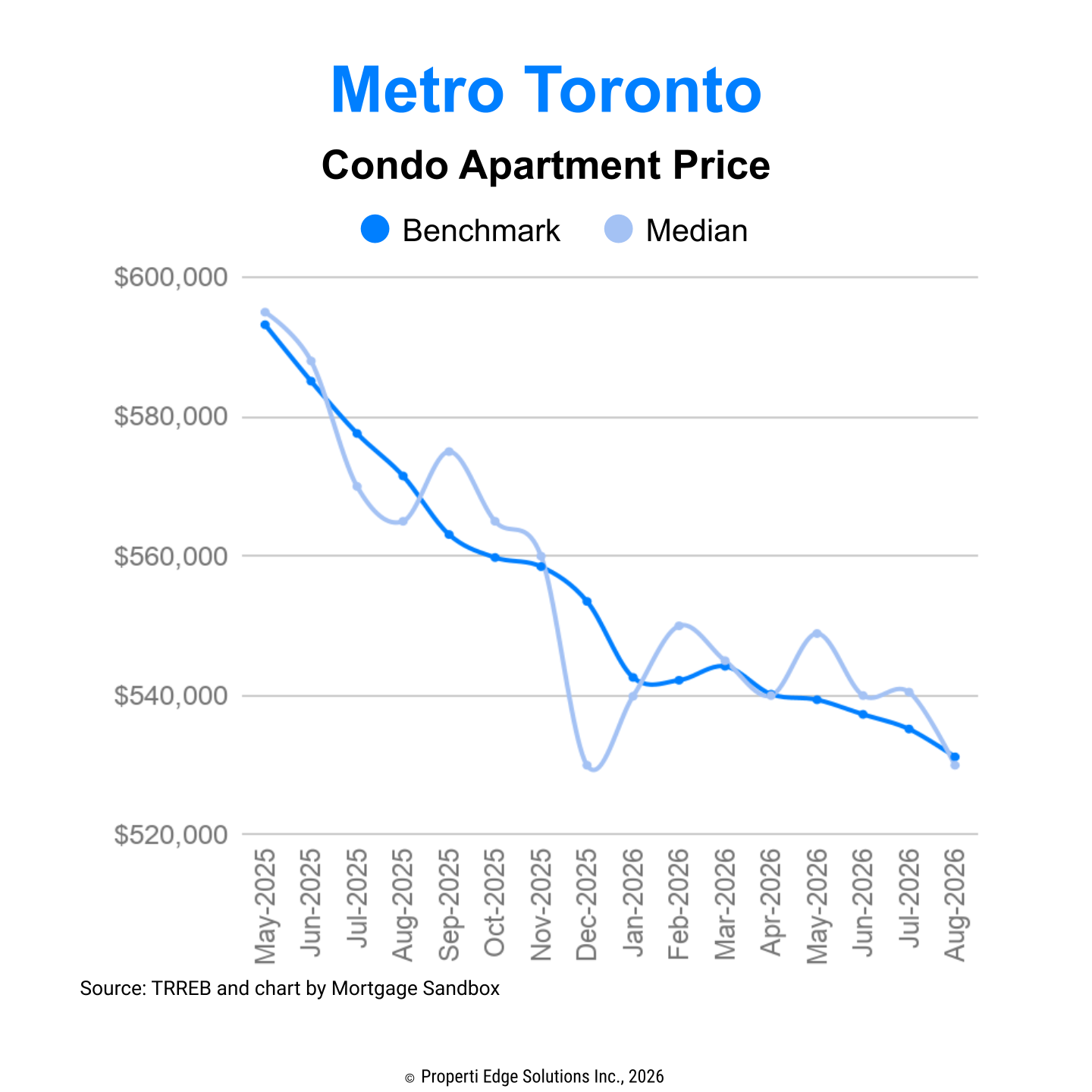
Metro Toronto Condo Benchmark vs. Median Price
Metro Toronto Townhouse Market Conditions
Townhouses mirror the broader market's balanced state, supported by modest gains in buyer demand alongside reduced listing volume. Months of supply decreased 7 per cent year-over-year, moving from 5.5 to 5.1 months.
Demand & Supply: Purchase demand rose 2 per cent, while active inventory dropped 6 per cent.
Price Movement: The benchmark townhouse price sits at $666,500, marking a 3 per cent decrease over three months and a 7 per cent drop year-over-year from $715,100. The median townhouse price is $660,000, down 3 per cent over the quarter.
Analyzing the Macro Risk Environment
Local Market Depth
Metro Toronto represents a deep property market with significant buyer density. Well-priced properties continue to find buyers even during quieter seasonal cycles.
Interest Rate & Bond Yield Cycle
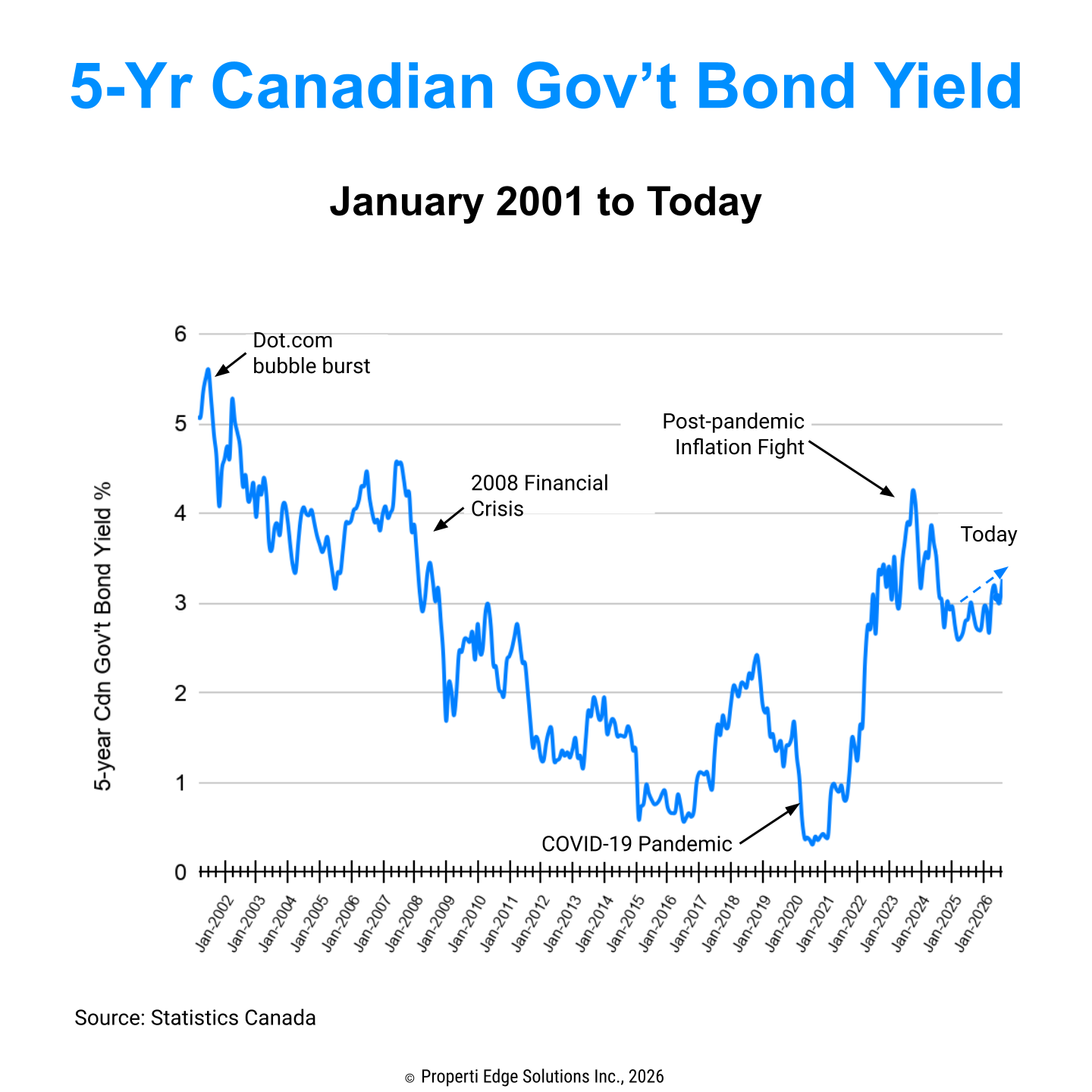
Interest rates have likely reached their lowest point for the current economic cycle, meaning buyers should not rely on monetary policy for further rate relief:
Bond Yield Dynamics: Upward pressure on global bond yields is pushing fixed mortgage rates higher, with mild increases anticipated through the end of 2027.
Bank of Canada Outlook: Central bank policy rates are expected to stay on hold through late 2026 before gradual rate increases begin in 2027 as economic momentum recovers. Because monetary policy changes take up to 18 months to fully filter through the economy, today's rate environment represents the near-term baseline.
Sector Risk Breakdown
| Property Type | Market Balance | Valuation & Risk | Construction Pipeline |
|---|---|---|---|
| Detached Houses | Balanced Market 4.7 Months of Supply | Bubble Risk 12.5x Median Income | Typical Supply Absorbed Easily |
| Condo Apartments | Balanced Market 5.9 Months of Supply | Affordable Level 5.5x Median Income | Typical Supply Absorbed Easily |
Detached House Risks
Valuation Stretch: Detached values remain disconnected from local household earnings. At 12.5 times local median household income, benchmark prices ($1.21M) carry bubble risk compared to sustainable ratios of 4 to 6 times income.
New Supply Absorption: Construction completions remain at typical historical levels, allowing new inventory to be absorbed without triggering sudden price shocks.
Condo Apartment Risks
Favourable Affordability Metrics: Unlike detached homes, Toronto condos present manageable valuation fundamentals, trading at 5.5 times median household income (within the sustainable 4 to 6 range).
Investor Sentiment: Despite grounded valuation ratios, ongoing investor withdrawal and elevated urban inventory are expected to keep condo price growth subdued into 2027.
Strategy: Current Conditions vs. Winter Outlook
With Metro Toronto in a balanced state, buyers today face less immediate bidding pressure than in peak spring cycles. Buying now allows purchasers to lock in property choices at 4 to 7 per cent discounts compared to last year's benchmarks.
However, historical seasonality suggests price softening tends to be more pronounced between late autumn and Christmas than during the spring months. For buyers willing to wait until December or January 2027, seasonal listing slowdowns and motivated winter sellers could yield further price concessions, though rising bond yields and potential 2027 rate hikes mean borrowing costs may not remain at today's lows indefinitely.