
Canadian Mortgage Rate Forecast, 2026 to 2029
Published November 19th, 2026 · By David Stroud
Our forecast for the 5-year fixed mortgage rate through 2027 (Properti Edge forecast, November 2026): low 4.6%, most likely 5.0%, high 5.3%. Forecasts are estimates, not a guarantee. The chart and table below track posted rates every week. Not regulated advice.
Canadian mortgage rates at a glance
- Bank of Canada: raised its policy rate by 0.25% to 2.50% on October 28th, 2026. Its next decision is December 9th, 2026.
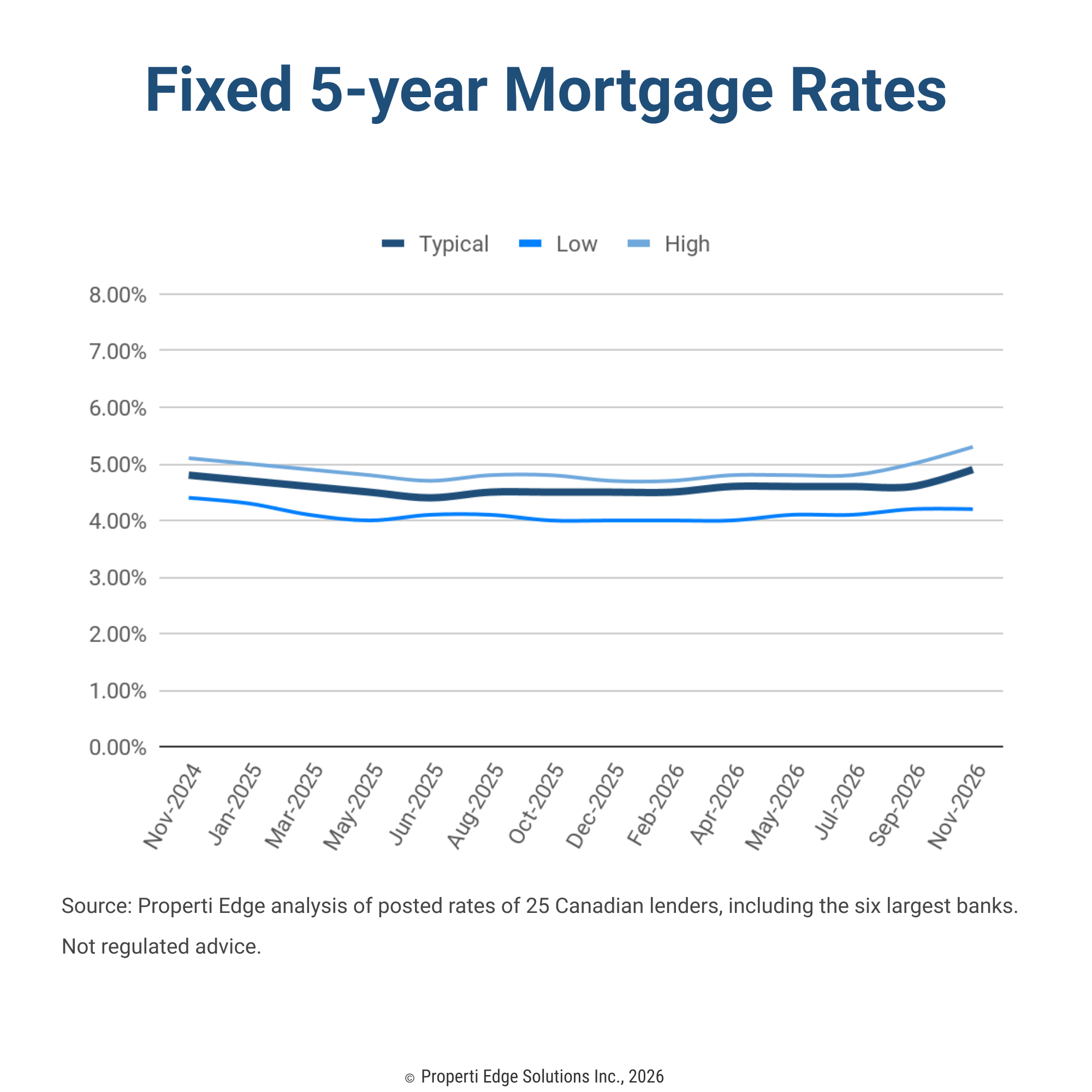
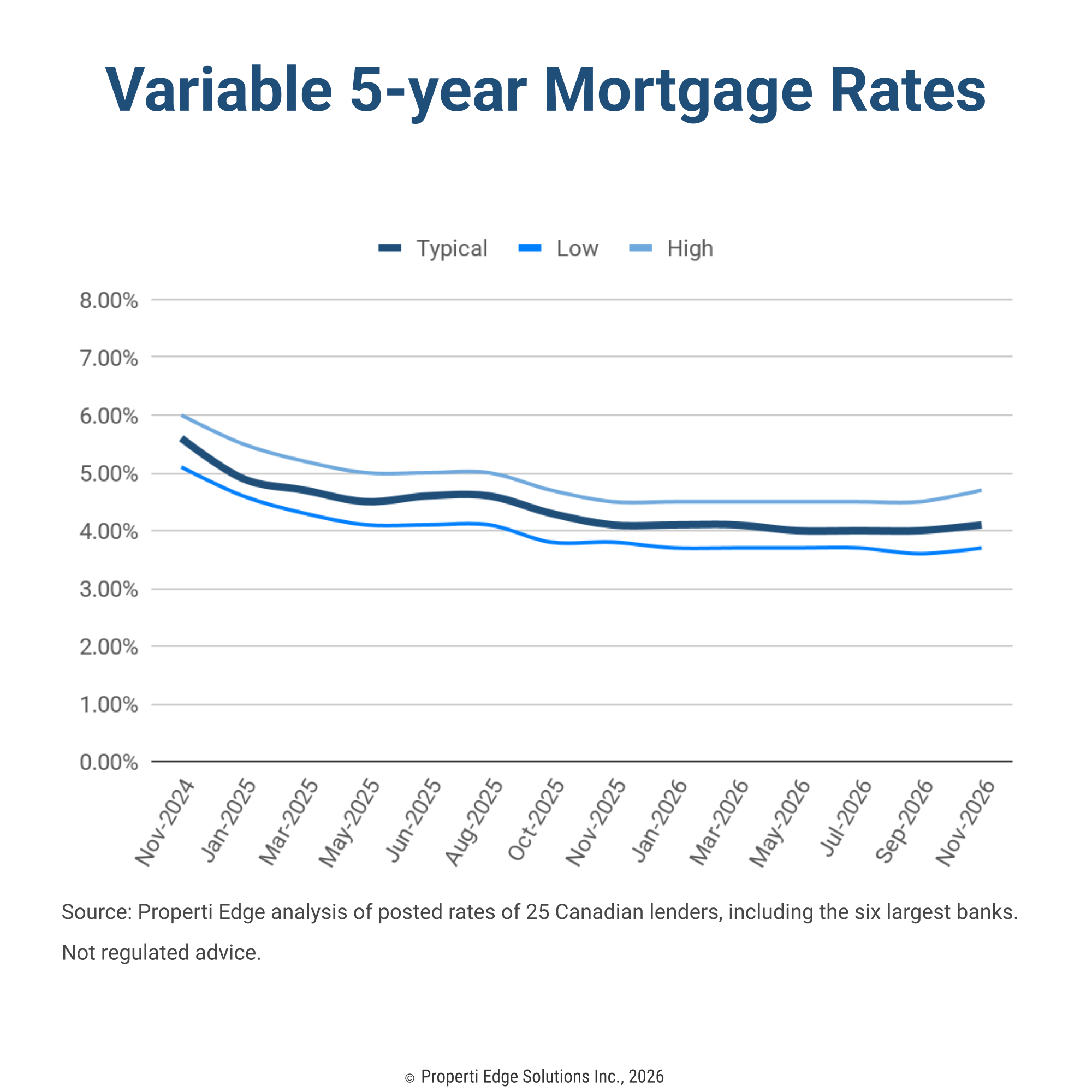
- Typical posted rates, week ending November 20th, 2026: 4.90% for a 5-year fixed mortgage and 4.10% for a 5-year variable mortgage.
- Forecast: the Properti Edge forecast, November 2026, puts the typical 5-year fixed rate between 4.6% and 5.3% through 2027, with about 5.0% most likely.
- Forecasts change: a forecast is a range, not a promise, and these will be updated after the December 9th decision.
The Bank of Canada raised its policy rate by 0.25% to 2.50% on October 28th, 2026, and said it may need to raise it further. The eight bank and credit union forecasts we track mostly expect a gradual rise from here, and mortgage rates have started to follow. This page shows what forecasters expect, the range we derive from them, and what it means for your next fixed or variable decision.
Work through your financing strategy Fixed or variable, the term, and when to renew, for your situation.
What are mortgage rates in Canada today?
Posted rates differ a lot from lender to lender. The chart below shows the typical, median and lowest posted rates for 5-year fixed, 3-year fixed and 5-year variable mortgages, across Canadian lenders.
What are posted mortgage rates in Canada this week?
Data as of the week ending November 20th, 2026.
| Term | Median posted rate | Rate a quarter of borrowers can beat | Lowest rate |
|---|---|---|---|
| 5-year fixed | 5.30% | 4.90% | 4.20% |
| 3-year fixed | 5.20% | 4.80% | 4.20% |
| 5-year variable | 4.70% | 4.10% | 3.70% |
Median posted rate: the middle of lenders' posted rates. Rate a quarter of borrowers can beat: the 25th percentile. Lowest rate: the lowest posted rate in the survey.
Source: Properti Edge analysis of posted rates of 25 Canadian lenders, including the six largest banks.
Week ending November 20th, 2026: the typical 5-year fixed rate was 4.90%, the rate a quarter of borrowers can beat. The median posted rate was 5.30% and the lowest was 4.20%. The typical 5-year variable rate was 4.10%, with a median of 4.70% and a lowest of 3.70%. A year earlier, the typical 5-year fixed rate was 4.50% (week ending November 14th, 2025). The lowest posted 5-year fixed rate has stayed at 4.20% since mid-September, while the typical rate rose from 4.60% to 4.90%, so the gap between the lowest and typical rates has widened.
Source: Rates across lenders: typical, median and lowest. Properti Edge analysis of posted rates of 25 Canadian lenders, including the six largest banks. Week ending November 20th, 2026.
What did the Bank of Canada do, and what comes next?
On October 28th, 2026 the Bank of Canada raised its policy rate by 0.25% to 2.50%. In its statement it said there could be a need to raise the rate further (Bank of Canada, October 28th, 2026). Its next decision is December 9th, 2026.
Jobs data gives the Bank mixed signals. Canada lost about 4,700 jobs in October and the unemployment rate rose to 6.7%, the highest in six months (Reuters, November 6th, 2026). Markets read that as a reason for caution: on November 6th, swap-market pricing put the chance of a December hike at about 36% to 40%, which makes it less likely than not (Reuters, November 6th, 2026).
Inflation is the other signal the Bank watches. Consumer prices rose 3.1% in the year to October, the same pace as September, driven by gasoline; excluding gasoline, prices rose about 2% (Statistics Canada, November 16th, 2026). The Bank said energy prices and tariffs are the main risks to its inflation outlook.
Where do forecasters expect the Bank of Canada rate to go?
Forecasters expect further, gradual increases. The average of the eight bank and credit union forecasts we track has the Bank of Canada rate rising from 2.50% to about 2.6% by the end of 2026, and then to between 2.8% and 2.9% through 2027 and 2028. The range is wide. The lowest forecasts see the Bank cutting back to 2.25%, and the highest see it reaching 3.25%, three more increases of 0.25%. All eight forecasts were written after the October 28th hike.
What is happening to the 5-year Government of Canada bond yield?
Five-year fixed mortgage rates follow the 5-year Government of Canada bond yield. The yield rose to 3.62% on October 28th, the day of the hike, then fell to 3.39% by November 5th as a stock-market sell-off sent investors toward government bonds (Bank of Canada daily yields, October 28th to November 5th, 2026). If the yield stays lower, it eases pressure on fixed rates. The Properti Edge forecast has the 5-year yield averaging about 3.5% at the end of 2026 and easing to about 3.3% by early 2028 (see the Government Rate Forecast chart above).
What have fixed and variable rates done recently?
Fixed rates: the typical 5-year fixed rate rose from 4.60% in late September to 4.90% in early November and held there the week ending November 20th. Variable rates: the typical 5-year variable rate was 4.00% through October. It rose to 4.10% after the Bank of Canada's hike, as lenders raised their prime rates. Variable rates are tied to the policy rate, so each Bank decision moves them quickly.
Source: Properti Edge analysis of posted rates of 25 Canadian lenders. Week ending November 20th, 2026.
Will mortgage rates go up or down through 2029?
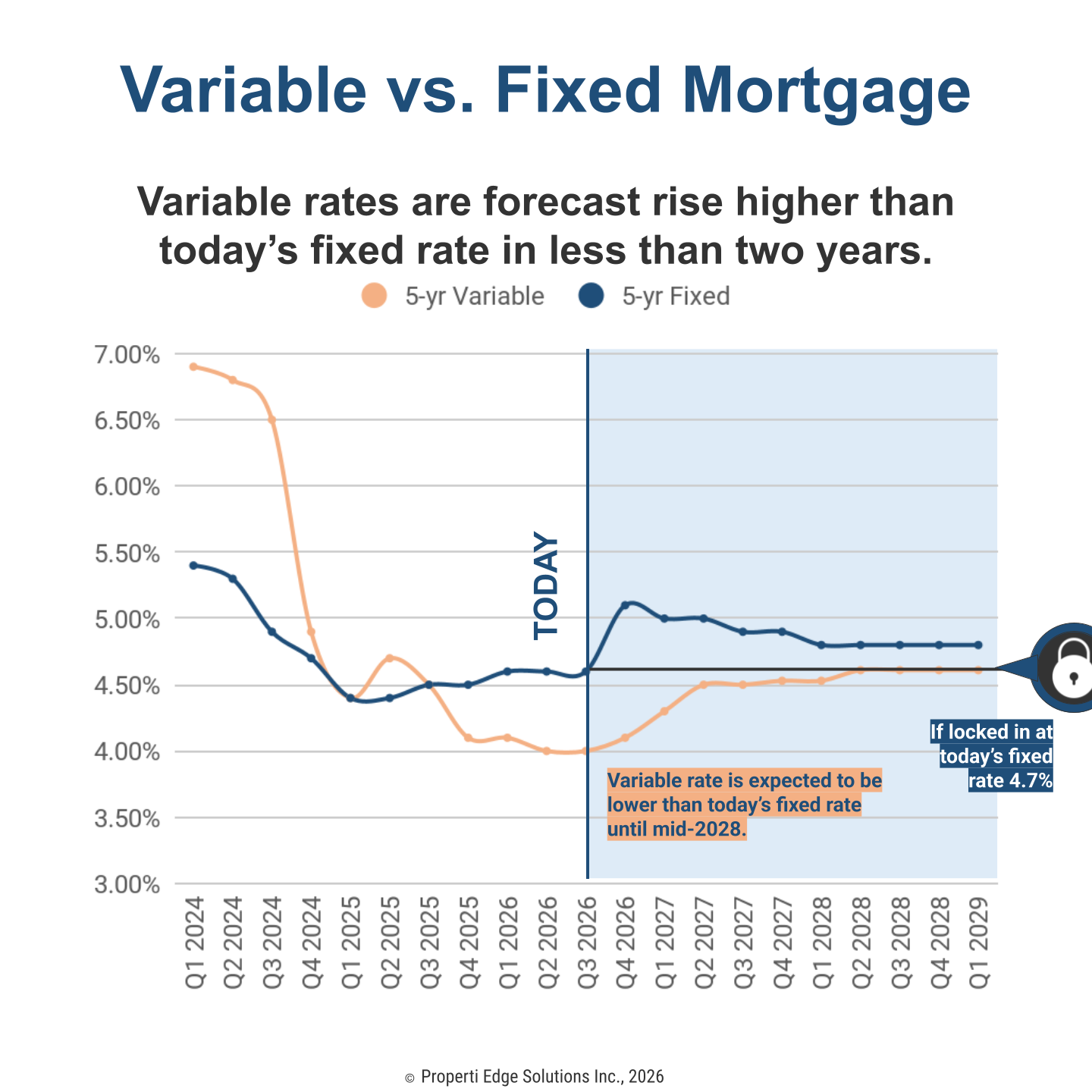
The chart shows the most likely path for the 5-year variable and 5-year fixed mortgage rates, with the lowest and highest forecasts, from the fourth quarter of 2026 to early 2029.
A forecast is a range of possible outcomes, based on the information available at the time it was made. This one is an average of other organisations' forecasts plus a mortgage spread. It is not a guarantee of what will happen, and it is not a prediction of any lender's rate.
Will the 5-year fixed rate fall further?
Not by much, on these forecasts. The most likely path holds about 5.0% through 2027 and eases to about 4.8% by the end of 2028. The bottom of the range stays at 4.6% through the middle of 2028, so a drop well below today's typical 4.90% is less likely. Fixed rates follow the 5-year bond yield, which forecasters expect to ease slowly.
How much further could variable rates rise?
The most likely path rises from 4.3% in the fourth quarter of 2026 to 4.7% by the second quarter of 2027, then eases to about 4.6%. The top of the range, 5.0%, assumes the Bank keeps raising its rate, and the bottom, 4.0%, assumes it cuts back to 2.25%.
Likely means more than a 75% chance. More likely means more than 50%. Less likely means less than 50%. Unlikely means less than 25%.
Fixed or variable: what to weigh
The cost comparison is the fixed rate you would lock in against the average variable rate you would expect to pay. Over the next seven quarters (the fourth quarter of 2026 to the second quarter of 2028), the forecasts put the average variable rate at about 4.6% most likely, in a range of 4.2% to 4.9%. Today's typical 5-year fixed rate is 4.90%. This covers less than two years of a five-year term. The variable rate costs less on the most likely path, but it can rise: at the top of the forecast range, variable costs about the same as fixed.
The case for fixed: a 5-year fixed rate gives payment certainty and shields you if inflation pushes the Bank to raise rates further. Cons: higher penalties if you break the mortgage early, and you do not benefit if a recession pushes rates down.
The case for variable: a lower starting rate and typically lower penalties to break the contract. Cons: your payments follow the Bank's decisions.
For some borrowers, a 3-year fixed term is a middle ground. The right choice depends on how much payment risk you can carry and your time horizon. Talk to a mortgage broker about your situation.
Check your buying power See a borrowing range for your income, debts and down payment at today's rates. A range, not an approval.
What higher rates mean for your budget
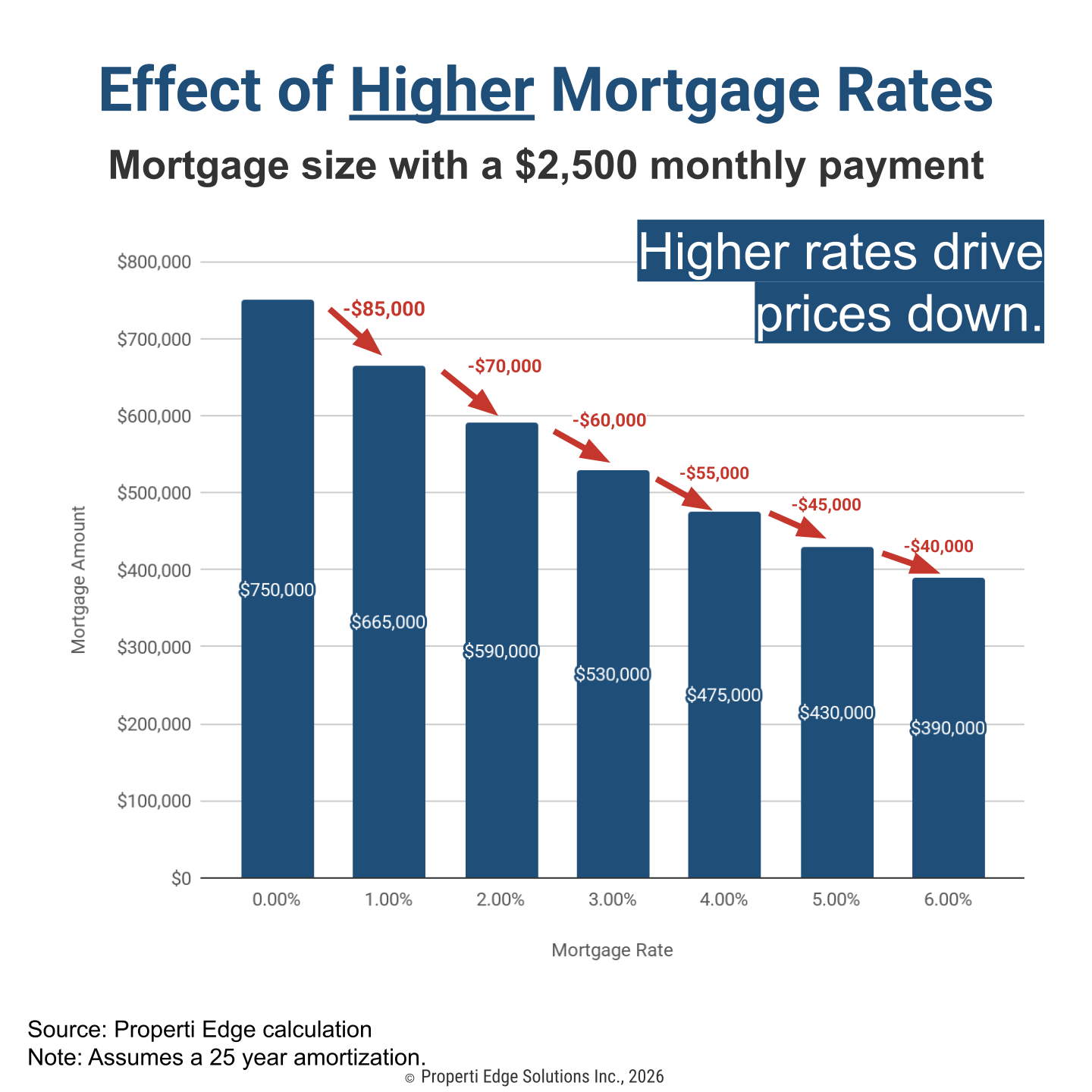
Buyers must qualify at the stress-test rate, which limits the size of the mortgage a lender will approve. When rates rise, the same income buys less house, transactions take longer, and buyers need to be disciplined with their budgets. A higher renewal rate raises payments for owners too, so it is worth knowing your renewal options 120 days ahead.
How to get the best mortgage rate
Start early and speak with an accredited mortgage broker about 120 days before your renewal or closing date. Brokers negotiate on your behalf and can help you navigate the fine print. Properti Edge doesn't recommend any specific mortgage product or lender.
Further reading: Our mortgage renewal guide and Penalties for early repayment.
What it means if you're buying
Rates have started to rise, and forecasters expect a gradual rise, not a sharp one. Compare what a payment looks like at today's rate and at a higher one, and get a pre-approval so you know your limit. Focus on homes you can comfortably afford, not the largest mortgage a lender will give you.
What it means if you're selling
Buyers' budgets are set by today's rates. Price your home to what buyers can borrow, and ask a real estate professional how rates are affecting buyers in your neighbourhood. Well-priced homes sell; overpriced ones sit.
Mortgage rates: common questions
Will mortgage rates go down in 2027?
Not by much, on current forecasts. The Properti Edge forecast, has the typical 5-year fixed rate holding near 5.0% through 2027 and easing only gradually toward 4.8% by the end of 2028, and the 5-year variable rate rising to about 4.7% before it levels off near 4.6%. A forecast is a range of possible outcomes, not a guarantee.
Should I lock in my mortgage rate today?
Properti Edge can't tell you that, because it depends on how much payment risk you can carry and your time horizon. A fixed rate gives payment certainty. A variable rate costs less on the forecast's most likely path but can rise if the Bank of Canada keeps raising its rate. Compare offers and talk to a mortgage broker. Not regulated advice.
When is the next Bank of Canada rate decision?
December 9th, 2026. On October 28th, 2026 the Bank raised its policy rate by 0.25% to 2.50%.
What is the average mortgage rate in Canada?
For the week ending November 20th, 2026, the typical posted 5-year fixed rate across 25 Canadian lenders was 4.90% and the typical 5-year variable rate was 4.10%. Rates differ by lender: the lowest posted 5-year fixed rate was 4.20% and the median was 5.30%.
How often is this page updated?
The posted rates chart is updated weekly, and the forecast is refreshed after each Bank of Canada decision.
From Properti Edge
Not sure your mortgage offer is a good one?
Compare mortgage options side by side and see how different terms and rate types change your payment.
Compare mortgagesPersonal insights, not regulated advice.
Sources and methodology
The Properti Edge forecast, is the average of 8 bank and credit union forecasts. We survey the most prominent Canadian banks and credit unions and their published forecasts.
Method: the Properti Edge forecast is the average of the eight forecasts, with the low and high from the same set. The variable rate is the Bank of Canada forecast plus a spread; the fixed rate is the 5-year bond forecast plus a spread. A forecast is probabilistic: it describes what could happen, not what will.
Posted rates: Properti Edge analysis of posted rates of 25 Canadian lenders, including the six largest banks.
Not regulated advice. Properti Edge doesn't recommend any specific mortgage product or lender.