Is Consumer Sentiment Signaling Further Home Price Drops Across Canada?
Key Takeaways
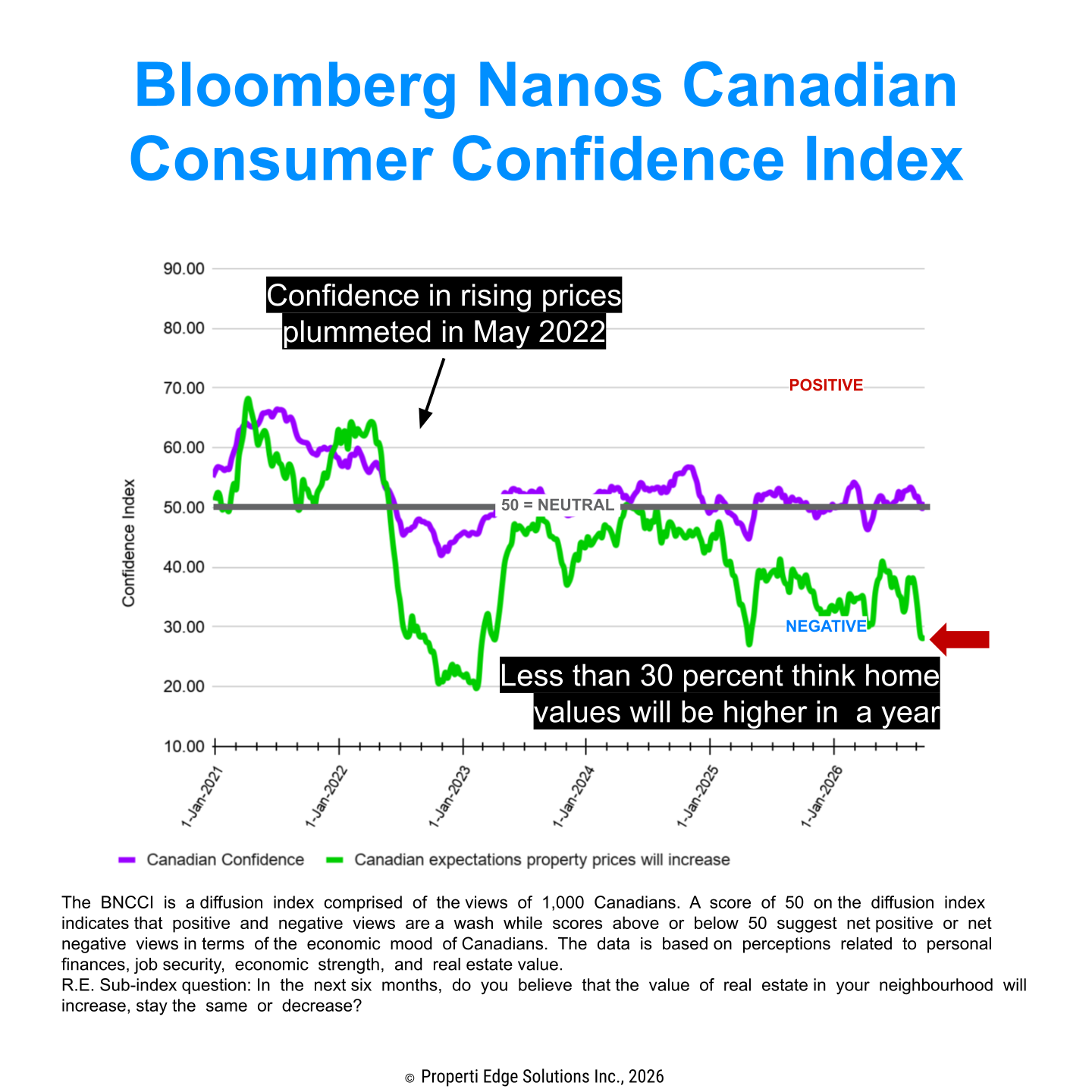
Plummeting Sentiment: According to recent Bloomberg Nanos Consumer Confidence Index data, fewer than 30 per cent of Canadians expect local home values to rise over the coming months, meaning over 70 per cent anticipate prices will stall or decline.
Coincident vs. Leading Indicator: Historical data shows real estate confidence often acts as a coincident or short-lag indicator rather than a long-term forecast, reflecting contract activity roughly two months prior to closing data.
Market Impact: The recent dip in confidence strongly signals further price softening and extended days on market across major Canadian centers, including Toronto, Vancouver, and Calgary.
Introduction: A Shift in Canadian Sentiment
Since the sharp interest rate hikes that began in mid-2022, Canadian consumer confidence has faced significant headwinds. While overall economic sentiment has oscillated near the neutral 50-point baseline, confidence in real estate price growth has taken a far more dramatic downturn.
According to the latest Bloomberg Nanos Canadian Consumer Confidence Index (BNCCI) data, fewer than 30 per cent of Canadians believe home values in their neighbourhood will be higher over the next six to twelve months. Put another way, more than 70 per cent of Canadians now expect property values to remain flat or decrease further.
This pronounced drop raises a critical question for buyers, sellers, and industry professionals alike: Is consumer confidence today a reliable predictor of tomorrow’s home values, and what does this mean for major real estate markets across Canada?
What Is Consumer Confidence and How Is It Measured?
Consumer confidence is a subjective economic metric designed to gauge the degree of optimism or pessimism individuals hold regarding their personal finances and the broader economy.
In Canada, the Bloomberg Nanos Consumer Confidence Index is widely recognized as a benchmark. Based on a rolling weekly survey of 1,000 households, the diffusion index tracks four core pillars:
Personal financial situations
Job security
Expectations for the national economy
Local real estate price expectations
A score of 50 on the diffusion index represents a neutral baseline where positive and negative responses balance out. While general Canadian economic confidence currently floats near the neutral 50 mark, the real estate sub-index has plunged deep into negative territory, hitting lows not seen since the immediate aftermath of the initial 2022 rate hikes.
Consumer Confidence as an Economic Predictor
In broader macroeconomics, consumer confidence is closely watched because consumer spending drives a major portion of gross domestic product (GDP).
A study by the Federal Reserve Bank of St. Louis confirmed that consumer confidence shares a statistically significant relationship with key economic indicators such as real GDP growth, employment levels, and retail sales. When households feel financially secure, they spend more freely; when anxiety rises, they curtail discretionary spending.
However, applying consumer sentiment directly to real estate price forecasting reveals notable limitations.
The Lag Effect: Indicator vs. Mirror
Analyzing historical transaction data alongside sentiment tracking, particularly in major markets like Toronto and Vancouver, suggests that consumer confidence is often a poor long-term predictive tool for home values.
Instead of leading the market by six to twelve months, real estate sentiment tends to move nearly simultaneously with market shifts:
The 60-Day Close Reality: Because typical Canadian home purchases require a 30- to 90-day closing window, sentiment changes registered in public surveys often reflect market conditions that are already occurring at the negotiation table.
Coincident Behavior: In prior market turns, consumer confidence in property values began falling only six to eight weeks before official land registry sales figures showed price contractions.
Therefore, today’s low sentiment is less of a crystal ball for late 2027 and more of a direct reflection of current buyer hesitations and market friction occurring right now.
Inflation Pressures: Could Interest Rate Expectations Squeeze the Market Further?
A major catalyst behind persistent consumer hesitation is the ongoing debate surrounding monetary policy and inflation. Although borrowing costs have fluctuated in recent quarters, persistent inflationary pressures in core sectors of the economy continue to raise expectations that interest rates may need to rise, or at least remain elevated for longer than previously anticipated.
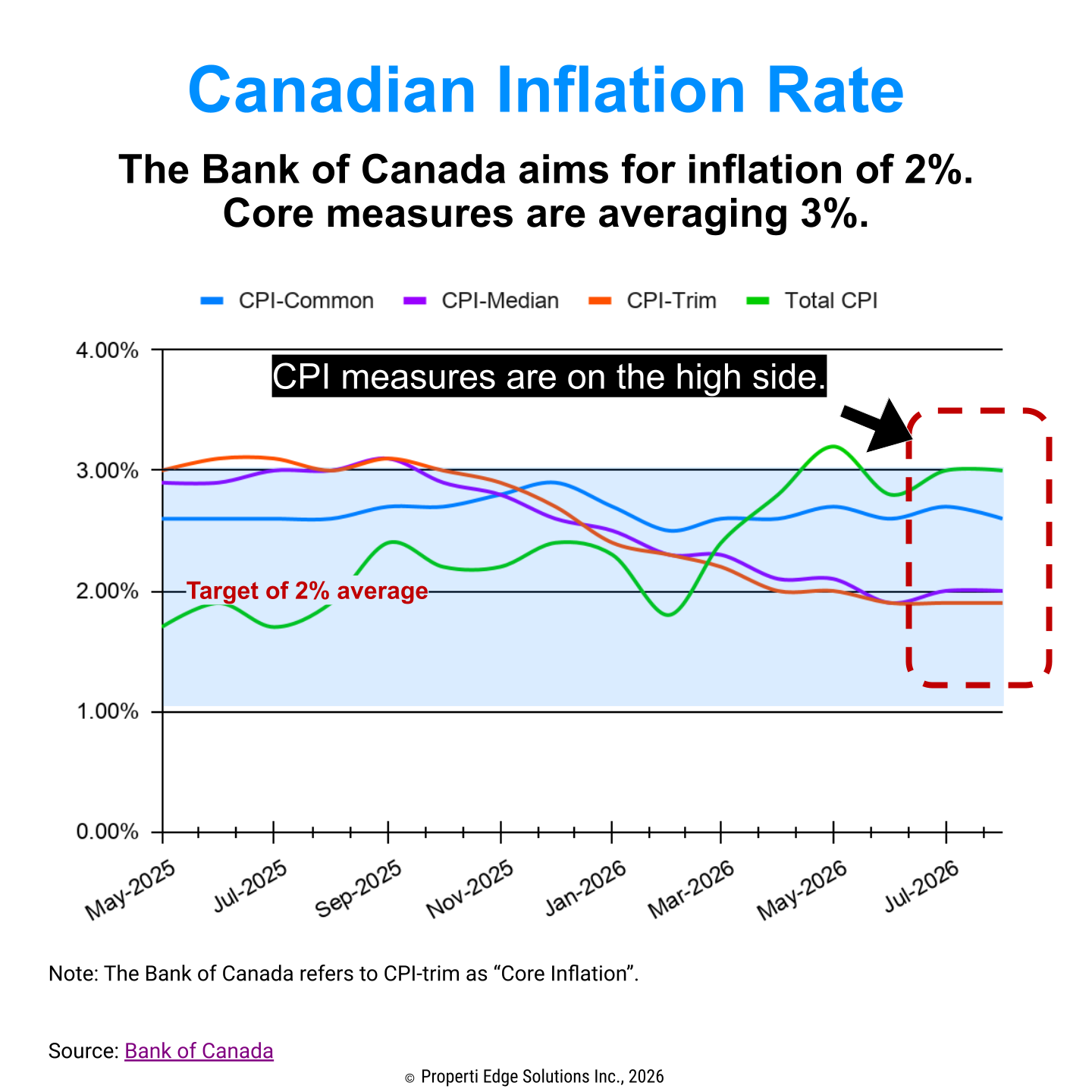
If inflation remains sticky, central bank policymakers may be forced to tighten monetary conditions further to keep price growth in check. For potential homebuyers, higher interest rates translate directly into stricter qualifying stress tests, higher monthly mortgage payments, and reduced borrowing capacity. This ongoing uncertainty keeps many prospective buyers on the sidelines, further dampening transaction volumes. Until inflation cools predictably and rate path expectations stabilize, borrowing costs will remain a formidable headwind for real estate demand across Canada.
Regional Forecast: What to Expect in Major Canadian Markets
Because sentiment acts as a real-time reflection of buyer psychology and mortgage affordability, the current dip indicates that major metropolitan markets will likely experience continued downward pressure on home values over the next several months.
Canadian Market Conditions
Regional sentiment and price outlook
| Market | Sentiment Driver | Near-Term Price Outlook | From peak | Peak date |
|---|---|---|---|---|
| Vancouver | Deep affordability gap, cautious buyers | Softening prices; longer days on market | -11.57% | Aug 2024 |
| Victoria | Affordability constraints; migration slowdown | Moderate softening; below-peak conditions | -6.45% | May 2022 |
| Kelowna | Post-pandemic correction; supply normalization | Stabilizing after sharp drawdown | -10.20% | Jul 2022 |
| Calgary | Supply catching up to demand; interprovincial migration cooling | Moderating growth; stabilizing after outperforming | -1.59% | Aug 2025 |
| Edmonton | Steady demand from interprovincial migration | Modest upside; resilient fundamentals | -0.05% | Jul 2026 |
| Ottawa-Gatineau | Measured correction; stable employment base | Gradual stabilization; modest downward pressure | -3.98% | Jun 2022 |
| Toronto | Inventory accumulation, high carrying costs | Moderate downward pressure; buyer-favourable conditions | -20.33% | May 2022 |
| Hamilton | Sharp correction from pandemic peak; inventory pressure | Continued adjustment; buyer-favourable | -22.37% | May 2022 |
| London | Significant post-peak adjustment; market rebalancing | Stabilizing after steep decline | -19.66% | Apr 2022 |
| Montréal | Supply constraints; cultural and lifestyle draw | Outperforming; positive momentum | -0.42% | Jun 2026 |
Source: Properti Edge Market Analysis, October 2026.
Price data from Teranet-National Bank House Price Index™ – August 2026 Composite 11 Report.
1. Greater Toronto Area (GTA)
The Toronto market remains sensitive to mortgage rate policy and high inventory levels. As sentiment remains subdued, potential buyers continue to stay on the sidelines, waiting for clearer signs of bottoming prices or lower borrowing costs. Expect inventory to build through the upcoming seasonal shifts, applying downward pressure on average benchmark prices in both the detached and condominium sectors.
2. Greater Vancouver Area (GVA)
Vancouver’s housing market continues to face historic affordability constraints. With over 70 per cent of consumers nationally expecting flat or declining property values, Vancouver buyers are showing little urgency. Sellers who overprice risk seeing listing durations stretch significantly, likely necessitating price reductions to close deals.
3. Calgary
While Calgary outperformed major coastal markets over recent years due to interprovincial migration and relative affordability, the national sentiment dip is beginning to temper local momentum. As inventory levels gradually rebuild, price growth in Calgary is expected to moderate, aligning more closely with broader national trends.
What This Means for Buyers and Sellers
Understanding the relationship between sentiment and market performance provides a strategic advantage for consumers navigating today's real estate environment.
For Homebuyers:
Increased Negotiation Leverage: With fewer buyers competing actively, purchasers can include financing and inspection conditions that were previously routinely waived during peak market conditions.
Time on Your Side: Hesitant overall sentiment means buyers face less pressure to make hurried decisions, allowing for thorough due diligence and price negotiation.
For Home Sellers:
Realistic Pricing Is Essential: Setting listing prices based on peak historical comparisons rather than active, real-time demand can lead to stagnant listings.
Focus on Value: Properties that are well-prepared, competitively priced, and presented strategically continue to transact even in low-sentiment environments.
Summary and Conclusion
Consumer confidence remains a valuable diagnostic tool for understanding the psychological state of the Canadian economic landscape. However, when evaluating property markets, sentiment acts predominantly as a real-time gauge rather than an advance forecast.
With fewer than 30 per cent of Canadians expecting home values to appreciate over the coming year, market dynamics strongly point toward further price adjustments, softer transaction volumes, and increased buyer leverage across major Canadian markets over the next few months.
Sources & References
Bloomberg Nanos Canadian Consumer Confidence Index (BNCCI) – Weekly Canadian Sentiment Tracker.
Federal Reserve Bank of St. Louis – Consumer Confidence and Economic Performance Analysis.
The Conference Board – Consumer Sentiment Research & Methodology.
Investopedia – Understanding Consumer Confidence Indicators.