
Okanagan Valley
Real Estate Trends and Price Forecast

HIGHLIGHTS
Prices Hold Their Ground: Okanagan values have steadied after a volatile run, with detached and townhouse benchmarks grinding higher and the condo picture turning in sellers' favour.
Softened Tightens: Inventory has pulled back across detached homes and condos, quietly chipping away at the buyer's advantage even where the market still reads as buyer-friendly.
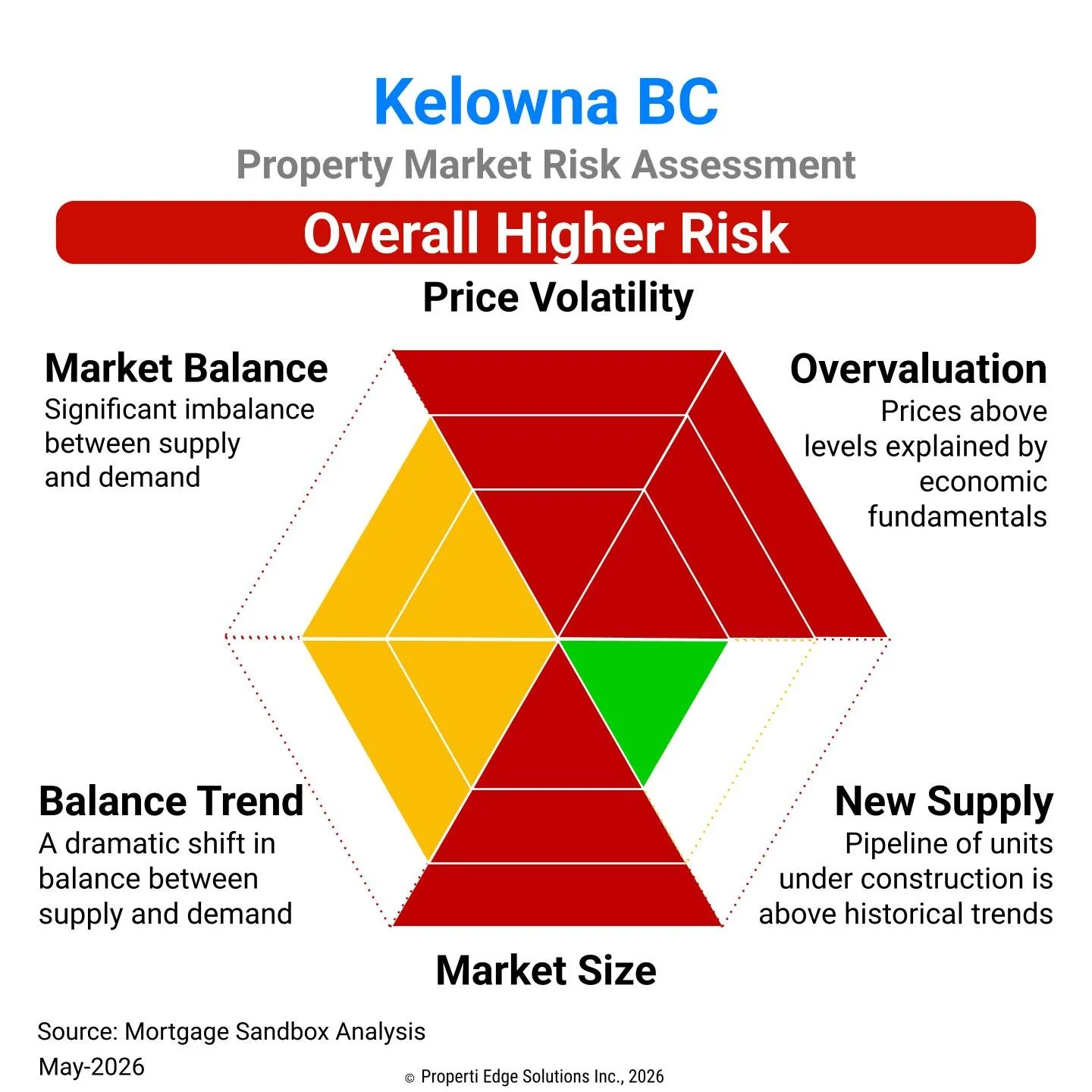
Higher-Risk Market: Multi-factor analysis continues to identify the Okanagan as a higher-risk real estate market.
Rates Risks Loom: Borrowing costs are low but unlikely to stay that way, and a small, thinly traded market leaves sellers exposed if momentum stalls.
Macroeconomic Headwinds: Economic uncertainty persists due to shifting immigration policies, trade wars, geopolitical tensions, and fluctuations in interest rates. All these factors heavily influence future market dynamics.
This article covers:
What is the state of the Okanagan property market?
Where are prices headed?
Is it a good time to sell a home in the Okanagan?
Is it a good time to buy an Okanagan property?
1. What is the State of the Okanagan Property Market?
The Okanagan Valley housing market is a study in crosscurrents. Detached homes and townhouses remain in buyer's territory, yet thinning inventory and firming prices are steadily pulling the advantage back toward sellers. The condo segment tells a sharper story still, with rebounding demand and a steep drop in supply pushing apartments into balanced ground after a soft stretch.
Home Price Overview
The Okanagan Valley in British Columbia holds a unique appeal, distinct from both Vancouver and Victoria. The region is highly sought after due to several key local factors:
Warm and Dry Climate: The Okanagan boasts a semi-arid climate, with hot, dry summers and mild winters. This is a major draw for those seeking sunny weather and an extended outdoor season.
Lake Lifestyle: The region is dotted with beautiful lakes, most notably Okanagan Lake, providing ample opportunities for swimming, boating, fishing, and other water sports.
Wine Country: The Okanagan is renowned for its thriving wine industry. Numerous wineries offer tastings and tours, attracting wine enthusiasts from around the world amidst beautiful vineyard scenery.
Outdoor Recreation: Beyond water sports, the Okanagan offers excellent hiking, biking, and golfing opportunities, alongside nearby ski resorts in the winter.
Agricultural Abundance: The region's fertile soil and sunny climate support a vibrant agricultural sector, making fresh local produce readily available at farmers' markets and roadside stands.
Relaxed Pace of Life: Compared to the bustling urban centres of Vancouver and Victoria, the Okanagan offers a more relaxed, laid-back lifestyle that appeals to those seeking a greater connection to nature.
Growing Communities: Towns like Kelowna are experiencing consistent growth, offering modern amenities and services that increasingly draw in people of all ages.
Common Themes Across Property Types
Across all three property types, the through-line is supply that is tightening faster than the headline market balance lets on. Prices have largely stabilized after a turbulent run, with detached and townhouse benchmarks edging higher and condo values firming, though affordability remains the stubborn obstacle. Detached prices sit far above what local incomes can comfortably support, while condos stay within closer reach. With borrowing costs low for now but poised to climb, and a small regional market that can turn illiquid in a hurry, the months ahead will test whether the recent firming in prices has staying power.

Okanagan Detached House Market Conditions
Months of Inventory and Market Balance
The detached segment remains a buyer's market, with purchasers still holding the stronger hand at the negotiating table. Yet the underlying current is shifting. Inventory has thinned over the past year, and that drawdown quietly favours sellers even as the headline balance continues to read in buyers' favour.
Price Trends
Prices have leaned toward sellers over the past quarter. The Central Okanagan benchmark detached price has edged higher, and the median price has climbed at a brisker pace, a sign that recent activity may be weighted toward the upper end of the market.
Purchases and Active Listings
Both sides of the ledger have cooled. Buyer demand has eased modestly, while the supply of active listings has fallen more sharply, tightening the field of available homes.
Metro Kelowna New Construction Home Prices
New home prices are experiencing a long-term decline. Because of this downward shift, some buyers who locked in pre-sale pricing during the peak years of 2022 and 2023 may find they paid significantly more than recent buyers purchasing within the exact same development.
Does this concern you? Read the Pros and Cons of Buying Pre-sale Homes

Our platform matches you with local, pre-screened, values-aligned Realtors.
Shared values make better working relationships.
Okanagan Condo Apartment Market Conditions
Months of Inventory and Market Balance
The condo market has settled into balanced territory, where buyers and sellers negotiate from roughly equal footing. The momentum, however, is clearly with sellers. Months of inventory have dropped steeply over the past year, one of the more pronounced swings across the region's property types.
Price Trends
The price picture is mixed. The benchmark apartment price has firmed appreciably in favour of sellers over the past three months, while the median price has slipped slightly, handing buyers a marginal advantage on completed deals.
Purchases and Active Listings
Demand has rebounded strongly, with purchases up sharply, while the supply of active listings has retreated. That combination, rising appetite against shrinking choice, is steadily eroding the buyer's edge.
Okanagan Detached Townhouse Market Conditions
Months of Inventory and Market Balance
Townhouses sit in a buyer's market, and unlike the rest of the region, the trend is widening that advantage. Months of inventory have risen over the past year, leaving sellers on the back foot and giving buyers room to take their time.
Price Trends
Despite the buyer-friendly backdrop, pricing has run firmly in sellers' favour. Both the benchmark and median townhouse prices have advanced over the past quarter, a rare show of strength against the broader buyer-dominant tone.
Purchases and Active Listings
Activity has slowed. Buyer demand has fallen noticeably, while the supply of active listings has dipped only slightly, meaning supply is holding up better than demand in this segment.
Sub-market Reports
Still a challenge for first-time homebuyers
Although Okanagan home prices have moderated, they are still not very affordable. A homebuyer household earning the local median before-tax income can only qualify for a modest mortgage. For that household to buy a standard condo, they would need to save a massive amount of cash for a down payment or receive a very generous financial gift from family. For most people, that is just not on the cards.

What about the rest of B.C.?
Read the Vancouver Home Price Forecast and Victoria Home Price Forecast.
Are you interested in specific areas of the Okanagan Valley? Try these reports!
2. Where are Okanagan Valley home prices headed?
There is a significant amount of uncertainty in the forecasts looking out toward 2027. Many of the forecasters surveyed have highly conflicting expectations regarding several major economic factors:
Will the federal government’s recent immigration policy pivot lead to a shrinking population?
Will mortgage rates drop back down to the lower percentage range that Canadians grew used to over the previous decade?
Will Canada’s trade tensions with major international trading partners lead to a broader recession?

Need a Realtor?
We match you with local, pre-screened, values-aligned Realtors and Mortgage Brokers.
To establish a clearer picture, real estate forecast analyzes various forecasts from leading lenders and real estate firms, balancing the most optimistic estimates against the most pessimistic predictions.
Our forecast inputs:

Get a mortgage broker to pre-approve you
Realtors want you to be pre-approved before you look at homes
Risks Outlook
Macro Risks
Local Market Size: This is a relatively small market with a relatively thin pool of buyers. In a slow stretch, sellers can struggle to find a buyer at all, even when they are prepared to make price concessions.
The Interest Rate Cycle: Rates are low, and the central bank has paused. Policymakers typically cut rates to address economic strain such as rising unemployment, then lift them once the problem clears. But they move on the data, and they will not raise rates until they are confident their goals have been met. Low rates stretch buyer budgets and stimulate the market, though the full effect of tightening can take up to a year and a half to work through.
Detached House Market Risk
Market Balance. With more than half a year of inventory on hand, this is a buyer's market. The supply backdrop is broadly in line with last year.
Price Fundamentals. Prices have held stable, but they have drifted well clear of local incomes, raising bubble risk. The benchmark sits at a multiple of median household income far above the four-to-six-times range generally considered sustainable.
New Housing Supply. Construction is running hotter than normal, which could create absorption challenges and push developers to dangle discounts or perks.
Condo Apartment Market Risks
Market Balance. With more than half a year of inventory, this remains a buyer's market, though months of supply are tightening strongly in sellers' favour.
Price Fundamentals. Prices have been highly volatile, but the segment stays within reach for most buyers, with the benchmark sitting at a multiple of local income near the upper end of the sustainable range.
New Housing Supply. Construction is running well above normal. Absorption challenges look likely, and developers may turn to price discounts or bonus amenities to draw buyers in.
4. Is It a Good Time to Sell a Home in the Okanagan?
For sellers, the window is more favourable than it might first appear, and it differs sharply by property type. Detached and townhouse benchmarks have been grinding higher, and tightening inventory is quietly returning leverage to sellers even though the headline market still reads as buyer-friendly. Condo owners are in arguably the strongest spot, with demand rebounding against a shrinking pool of listings and the segment swinging from soft to balanced.
That said, the broader macroeconomic picture is exerting downward pressure on the market, which argues for acting sooner rather than waiting several years for conditions to turn. Sellers should also remember that the annual cycle tends to break in their favour through the first half of the year. Townhouse sellers in particular are riding firm pricing despite a buyer's-market backdrop, a divergence worth capitalizing on while it lasts. Speaking with a mortgage professional early can help secure flexible terms and sidestep costly cancellation penalties.
Planning to Sell? Check out our Complete Home Seller’s Guide.

Fixed or Variable rate mortgage?
Find out where mortgage rates are headed before you start to negotiate.
5. Is It a Good Time to Buy an Okanagan Property?
For buyers, the calculus is shifting, and not entirely in their favour. Detached homes and townhouses remain in buyer's territory, but the supply that has long underpinned that advantage is thinning, and prices in both segments have been edging upward rather than retreating. The condo market has moved fastest of all, with demand surging, listings drying up and months of supply falling steeply, eroding the bargaining power buyers grew used to.
Buyers still have levers to pull. The annual cycle tends to tilt toward them in late summer and autumn, and borrowing costs, while low for now, are a meaningful tailwind for budgets. Townhouse buyers retain the clearest edge, as rising inventory in that segment leaves more room to negotiate. But with affordability still stretched on the detached side and the condo market firming quickly, the case for waiting is weaker than it was. Anyone buying for the long haul, a decade or more, faces lower risk than a year ago. Drive a hard bargain, aim close to fair value, and avoid overextending past your financing comfort zone.
Planning to Buy? Check out our Complete Home Buyer’s Guide so we can walk you through the end-to-end process and get you ready to buy your new home!

How much home can you afford?
Our mortgage calculator takes uses up-to-date mortgage rates and calculates the price of a home you could afford.
Here are some recent headlines you might be interested in:
Toronto and Vancouver housing bubble risk eases, UBS index finds (Wealth Professional | Sep 25)
Bank of Canada's Macklem flags risk of delaying rate hike too long (Bloomberg | Sep 21)
CMHC expects housing starts slowdown to continue toward year-end (REM | Sep 16)
Canada's fixed mortgage rates surge higher as bond yields continue to rise (Toronto Star | Sep 03)
How immigration changes are contributing to B.C.'s housing market slowdown (CBC News | Sep 01)
B.C. judge rules $30.5M in Burnaby condo pre-sales 'unenforceable' (Business in Vancouver | Aug 26)
Kelowna housing market is stuck, stuck, stuck (KelownaNow | Aug 08)
Like this report? Like us on Facebook.