
Metro Edmonton
Real Estate Trends and Price Forecast

HIGHLIGHTS
Mixed Price Performance: Metro Edmonton home values have shown mixed results across property types, with detached houses posting modest short-term gains while townhouse and apartment prices have trended downward over the past year.
Improving Supply: Inventory levels have risen meaningfully compared to the previous year across all property types, giving buyers more selection and improved negotiating power, though the market continues to favour sellers overall.
Moderate Market Risk: Multi-factor analysis continues to categorize Metro Edmonton as a moderate-risk real estate market.
Easing Interest Rates: Mortgage rates have eased from their earlier peaks, although borrowing costs remain higher than those seen in the previous decade.
Macroeconomic Factors: Economic uncertainty persists due to shifts in Canada’s immigration policy, ongoing trade tensions, and war in Iran that could influence employment, inflation, rates, and buyer confidence.
This article covers:
What is the current state of the property market?
Where are prices headed?
Risks in the Edmonton Market
Should investors sell?
Is this a good time to buy?
1. What is the current state of the Edmonton property market?
Overview of the Edmonton Property Market
According to recent global city reports, Metro Edmonton holds a strong position among the world's top one hundred cities, supported by a growing population. As the capital of Alberta, Edmonton offers a vibrant and dynamic lifestyle that blends urban amenities with a strong sense of community spirit. While it may not always rank as highly on the same global livability lists as its southern neighbour, it boasts its own unique set of advantages that make it a compelling place to call home.
A Festival City with a Cultural Heart: Edmonton is renowned as "Canada's Festival City," hosting a diverse array of events throughout the year. From the world-famous Edmonton International Fringe Theatre Festival to the Edmonton Folk Music Festival, there's always something happening to engage and entertain. The city's thriving arts scene, including the Art Gallery of Alberta and the Citadel Theatre, contributes to its rich cultural landscape.
Economic Diversification and Growth: While traditionally associated with the oil and gas industry, Edmonton's economy is diversifying rapidly. The city is becoming a hub for technology, healthcare, education, and advanced manufacturing. This economic growth translates into ample job opportunities and a promising future for residents.
Affordable Living and Real Estate: Compared to other major Canadian cities, Edmonton offers a more affordable cost of living, particularly in terms of housing. Whether you're a first-time buyer or looking to rent, you'll find a wider range of options and better value for your money. This affordability makes it an attractive destination for young families and professionals.
River Valley and Green Spaces: Edmonton boasts the largest urban parkland in North America, the North Saskatchewan River Valley. This expansive green space offers endless opportunities for outdoor recreation, including hiking, biking, picnicking, and cross-country skiing. The river valley provides a natural oasis within the city, promoting a healthy and active lifestyle.
Strong Educational Institutions: Edmonton is home to reputable post-secondary institutions, including the University of Alberta, NAIT (Northern Alberta Institute of Technology), and MacEwan University. These institutions attract students from around the world and contribute to its intellectual and cultural vitality.
A Welcoming and Community-Oriented City: Edmontonians are known for their friendly and welcoming nature. The city has a strong sense of community, with numerous neighborhood events and initiatives that bring people together. This sense of belonging makes it easy for newcomers to feel at home.
Edmonton continues to offer an attractive mix of relative affordability, employment opportunities, and cultural vibrancy. After a period of tight supply and rising prices, inventory has expanded, improving conditions for buyers. Despite the buyer-friendly trend, the market still leans slightly toward sellers due to underlying demand and ongoing economic momentum.

Metro Edmonton Detached House Prices
Detached house prices have shown modest upward growth over recent months, while gains over the past year have been more subdued. Buyer purchase demand has softened noticeably and inventory levels have improved, giving buyers more breathing room in the market.
Despite these rising inventory numbers, the market remains firmly in seller-advantage territory, meaning sellers continue to hold the upper hand during negotiations. Looking forward, overall market conditions are expected to gradually trend toward a more balanced state as new housing supply enters the system. Policymakers continue to promote sustainable growth aligned with household income trends, aiming to avoid the overheating seen in prior cycles.
Metro Edmonton New Construction Home Prices
New home prices are falling as elevated construction activity meets a more selective pool of buyers. Developers are adapting through incentives and enhanced amenities to sustain absorption rates. With a significant volume of homes still under construction, the focus is shifting from expansion to stabilization as the market absorbs new supply.
Does this concern you? Read the Pros and Cons of Buying Pre-sale Homes
There is a record number of housing starts, homes under construction, and completions could be saturating the market.

Our platform matches you with local, pre-screened, values-aligned Realtors.
Shared values make better working relationships.
Metro Edmonton Condo Apartment Prices
Condo apartment prices have shown a mixed performance, with short-term values rising according to benchmark measures while dropping according to median tracking over the same period. Over the past year, overall apartment benchmark values have trended downward, moving in favour of buyers.
A significant softening in purchase demand, combined with an increase in the months of available inventory, has given buyers more leverage during negotiations. Even with improved inventory levels and weaker demand, the market remains technically classified as a seller's market due to baseline interest from out-of-province investors and buyers seeking affordable urban options.
A CBC News report highlighted that Alberta has attracted the attention of many Ontario real estate speculators. Lower price-to-rent ratios and landlord-friendly tenancy laws continue to attract out-of-province investors.
Metro Edmonton Townhouse Prices
Townhouse prices have shown a mixed short-term performance, with benchmark values edging slightly upward while median values have softened modestly. Purchase demand for townhouses has dropped sharply, which has allowed overall inventory levels to improve for buyers.
While these changing dynamics offer buyers a better selection and enhanced negotiating power, the segment still behaves as a seller's market overall, leaving sellers with the upper hand in negotiations. First-time buyers continue to find excellent value here, though long-term growth is projected to stabilize.
Why Edmonton Homes Remain Highly Affordable for First-Time Homebuyers
Edmonton’s home prices are very affordable. A first-time homebuyer household earning the median Metro Edmonton household before-tax income can comfortably secure a mortgage large enough to buy a condo or townhouse, buying a detached house is now moving out of reach for a significant portion of Edmontonians.

What about the rest of the West?
Read the Vancouver Home Price Forecast, Okanagan Valley Home Price Forecast and Calgary Home Price Forecast.
2. Where are prices headed?
Looking ahead to the coming years, most forecasts anticipate modest price movements rather than sharp swings. The range of possible outcomes depends heavily on how interest rates evolve, whether migration levels recover, and how trade policies influence Alberta’s economic performance.
If borrowing costs trend higher, as forecast, home prices may experience renewed downward pressure by late 2027 as affordability deteriorates. If supply continues to expand faster than demand, the market could shift toward a buyer’s market with falling home values. With many unknowns, forecasters expect a wide range of moderate outcomes.
Critical External Factors Influencing the Market
Will the federal government’s recent immigration policy pivot lead to a shrinking population?
Will the war in Iran lead mortgage rates to begin rising again?
Will regional trade tensions lead to a broader economic recession?
How do we arrive at our forecast range? Check out our full assessment of the five factors that drive these forecasts. These five forces help explain why several forecasters are anticipating price drops.

Need a Realtor?
We match you with local, pre-screened, values-aligned Realtors and Mortgage Brokers.
At Mortgage Sandbox, we provide a price range rather than attempting a single prediction because many real estate risks can impact prices. Risks are events that may or may not happen. As a result, we review several forecasts from leading lenders and real estate firms, and we then present the most optimistic estimates, the most pessimistic prediction, and the average forecast.
Want to learn more about real estate risk? We've written a comprehensive report explaining the risk levels in the Canadian real estate market.
Our forecast inputs:

Get a mortgage broker to pre-approve you
Realtors want you to be pre-approved before you look at homes
3. Edmonton Property Market Risk Assessment
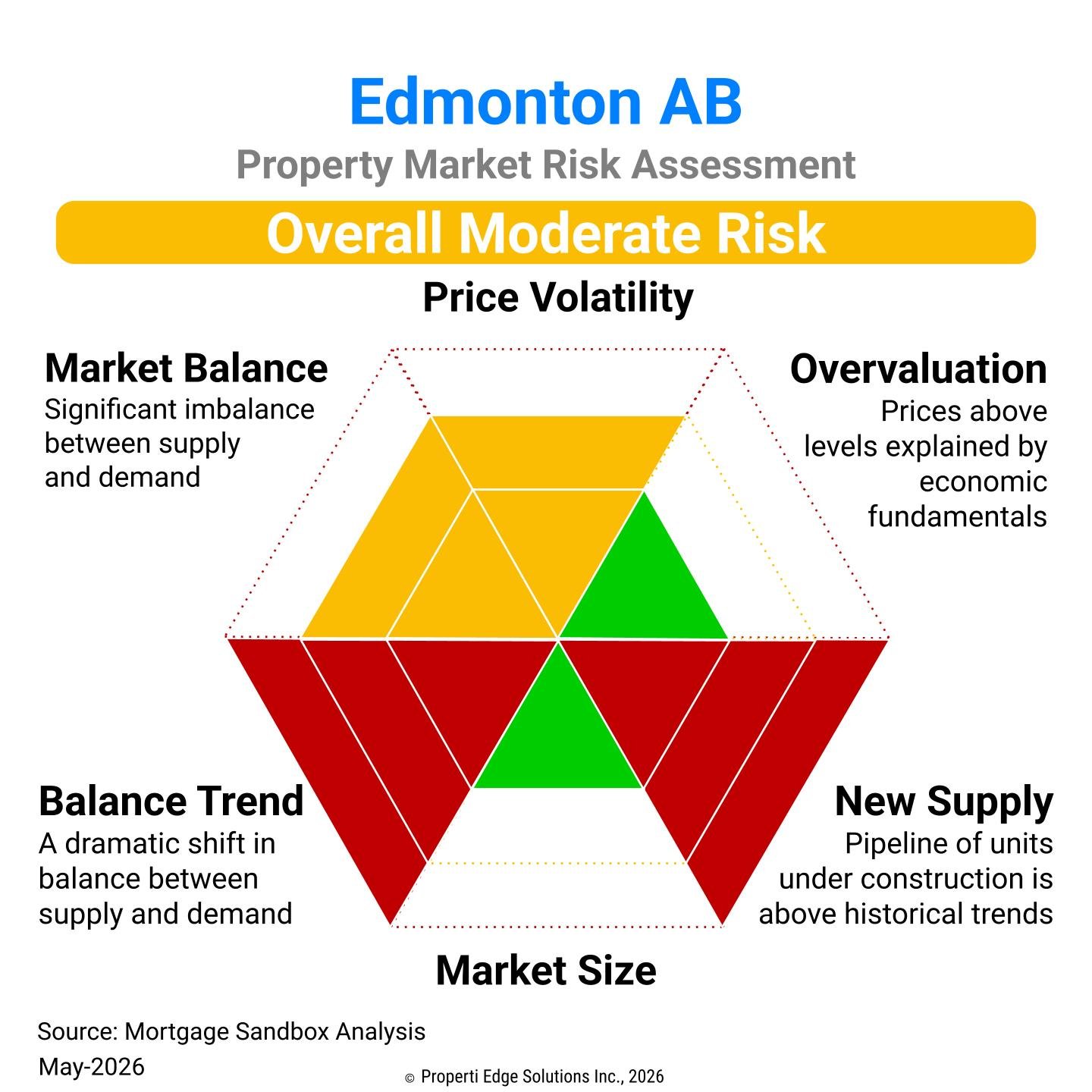
An analysis of market conditions indicates that Metro Edmonton remains at a moderate risk of a housing market correction. While underlying economic fundamentals and overall affordability provide a strong anchor, distinct structural risks exist across different property types, particularly regarding future inventory absorption and price volatility.
Detached House Risk Profile
The detached housing segment currently demonstrates a balanced mix of strong structural demand and notable historic price volatility:
Market Balance: With months of inventory having increased noticeably compared to the previous year, the detached segment remains in seller's market territory, though conditions are gradually becoming more balanced.
Price Volatility & Affordability: Detached house prices have historically experienced high levels of volatility. However, housing values remain sustainable relative to local incomes, with benchmark prices sitting comfortably within a healthy multiple of the median household income.
Supply & Demand Dynamics: Construction levels for single-family homes remain typical for the region. The local market is well-positioned to steadily absorb completed units without triggering downward pressure on prices. Additionally, because this is an average-sized market with a diverse buyer pool, sellers can reasonably expect to find buyers even during broader economic slowdowns.
Condo Apartment Risk Profile
The condo apartment segment presents a contrasting risk landscape, where excellent baseline affordability is heavily counterbalanced by elevated supply risks:
Market Balance: Similar to the detached house sector, inventory levels technically keep the apartment segment in a seller's market, though supply has grown meaningfully compared to the previous year
Price Volatility & Affordability: Apartment prices exhibit moderate historic volatility. From an affordability standpoint, condos are highly accessible, with benchmark values sitting well below the traditional income-to-price threshold.
Supply & Absorption Risks: The primary vulnerability for apartments stems from exceptionally high construction volumes. The market is facing significant absorption challenges, meaning developers may increasingly rely on price concessions, discounts, or enhanced amenities to attract buyers.
Liquidity Risk: Because the apartment segment represents a relatively small piece of the local market with a smaller pool of active buyers, sellers may face distinct challenges finding buyers during a market slowdown, even after reducing their price expectations.
Macroeconomic Factors: Interest Rates and Monetary Policy
Both property segments are highly sensitive to the broader economic environment and current interest rate trajectories:
Stimulative Environments: Interest rates are currently low, which naturally expands homebuyer budgets and creates a stimulative effect across the entire property market.
The Monetary Policy Lag: The central bank has paused rate adjustments, remaining entirely dependent on economic data. Typically, monetary policy is eased to counteract economic headwinds like rising unemployment; once those issues resolve, interest rates tend to climb again. The central bank will not adjust borrowing costs until they are confident their economic milestones have been fully achieved.
Key Risk Consideration: It can take up to eighteen months for the full macroeconomic impact of monetary policy tightening or shifting interest rates to filter completely through the real estate market.
4. Is it a good time to sell your Edmonton property?
For buyers, improved selection and softening demand offer a better chance to negotiate terms. Mortgage rates are lower than their recent peaks, enhancing purchasing power and supporting sales activity through the mid-term. The usual seasonal cycle continues to favour buyers later in the year when sellers may be more willing to negotiate.
Those entering the market should be patient and budget-conscious, focusing on long-term affordability rather than short-term price movements. Edmonton’s market fundamentals remain sound, suggesting a stable environment for well-considered purchases over the next few years.
Planning to Sell? Check out our Complete Home Seller Guide

Fixed or Variable rate mortgage?
Find out where mortgage rates are headed before you start to negotiate.
5. Is this a good time to buy a home in Edmonton?
For buyers, improved selection and softening demand offer a chance to negotiate better terms. Mortgage rates are lower, enhancing purchasing power and likely to support sales activity through to mid-2027. The usual seasonal cycle continues to favour buyers later in the year when sellers may be more willing to negotiate.
Those entering the market should be patient and budget-conscious, focusing on long-term affordability rather than short-term price movements. Edmonton’s market fundamentals remain sound, suggesting a stable environment for well-considered purchases through 2027 and 2028.
Are you planning to Buy? Check out our Complete Home Buyer’s Guide so we can walk you through the end-to-end process and get you ready to buy your new home!

How much home can you afford?
Our mortgage calculator takes uses up-to-date mortgage rates and calculates the price of a home you could afford.
Here are some recent headlines you might be interested in:
Toronto and Vancouver housing bubble risk eases, UBS index finds (Wealth Professional | Sep 25)
Bank of Canada's Macklem flags risk of delaying rate hike too long (Bloomberg | Sep 21)
CMHC expects housing starts slowdown to continue toward year-end (REM | Sep 16)
Canada's fixed mortgage rates surge higher as bond yields continue to rise (Toronto Star | Sep 03)
Like this report? Like us on Facebook.