
Metro Vancouver Real Estate Report: April 2026 | Buyer’s Markets Prevail Amid Shifting Trends
April 2026 begins with mixed signals for Metro Vancouver’s housing market. Both detached houses and condo apartments remain in buyer’s market territory, meaning people looking to buy generally have more negotiating power. However, new trends are emerging. Interest rates, global conflicts, and local pricing issues are all shaping what buyers and sellers can expect. This report breaks down the latest numbers for detached homes and condos, then examines the risks that could reshape the market in the coming months.
Market Overview: Two Buyer’s Markets, Different Directions
A buyer’s market means there are more homes for sale than there are active buyers. The key measure is “months of inventory” – how long it would take to sell all current listings at the current sales pace. More than six months typically favours buyers. Both market segments are above that mark, but they are trending in different directions.
Detached houses: Still a buyer’s market, but moving slightly in favour of sellers. Inventory levels have dropped, which takes away some buyer advantage.
Condo apartments: A buyer’s market that continues to favour buyers. Inventory levels are almost unchanged from last year.
Let’s look at each segment in detail.
Detached House Market: Prices Drop, Demand Rises
Months of Inventory
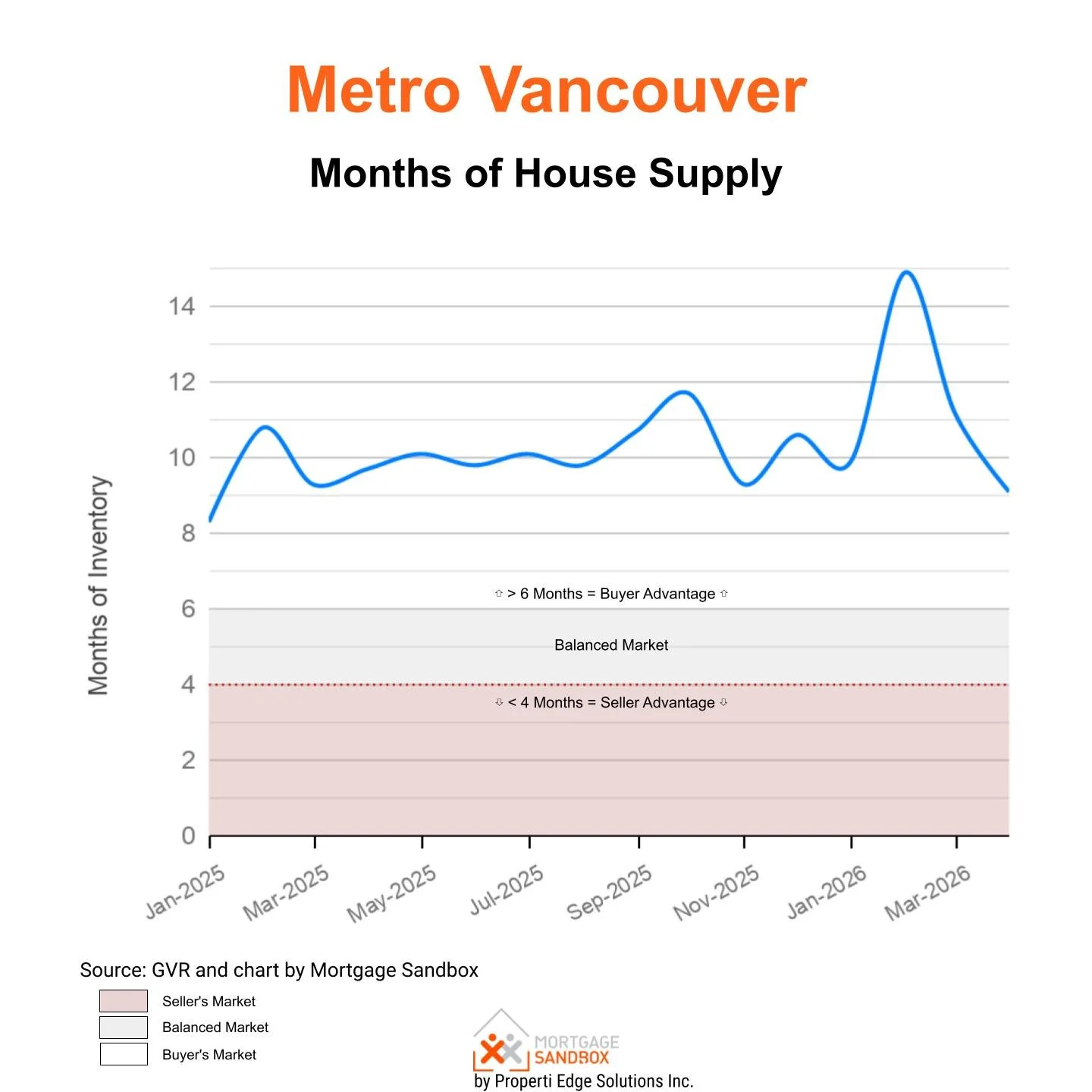
In March 2026, detached houses had 9.1 months of inventory. That is down 6 percent from 9.7 months one year ago. While this is still very much a buyer’s market, the drop indicates the market is tightening slightly. Sellers are seeing slightly less competition from other listings, though buyers still hold the upper hand in price negotiations.
Purchases and Active Listings
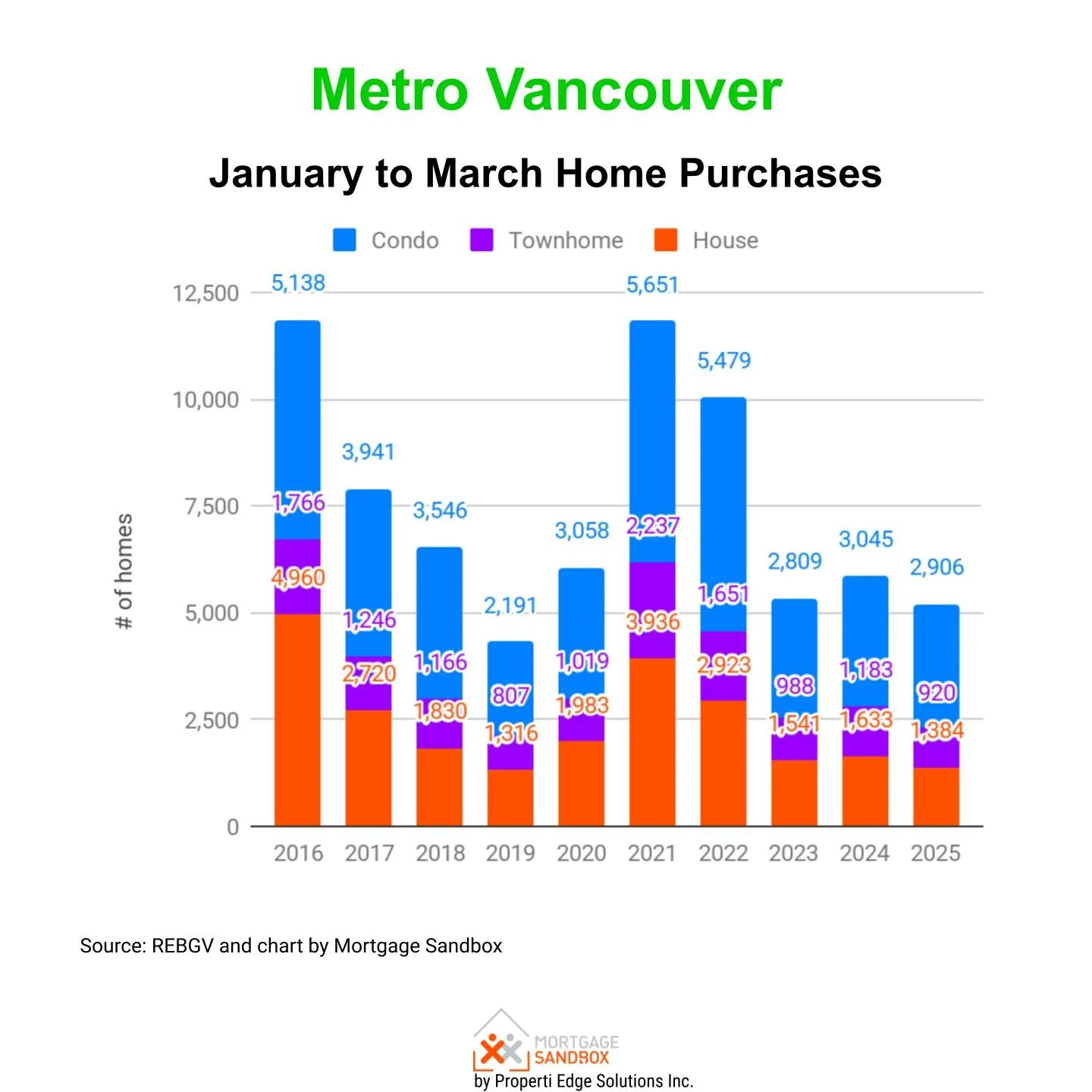
Purchase demand has increased 8 percent compared to last year. More people are deciding to buy detached homes. At the same time, the supply of active listings has gone up by 2 percent. So both buyers and sellers are more active than before. The increase in demand is outpacing the increase in supply, which helps explain why the market is trending away from an extreme buyer’s advantage.
It is possible that some people, upon hearing about the potential impact of the war in Iran on mortgage rates, decided to act quickly and purchase homes before rates rise. They may have chosen to do this instead of waiting for lower prices in six months, which would have come with more difficult mortgage financing.
Price Trends
The benchmark price for a detached house is now $1,854,800. Over the past year, that price has dropped 9 percent, which is good news for buyers. Looking at the last three months alone, the price fell another 1 percent. So the downward trend continues, but at a slower pace.
To put that in dollars: one year ago the benchmark price was $2,034,400. Today it is almost $180,000 lower. That is a significant shift in favour of people looking to buy a detached home in Metro Vancouver.
Condo Apartment Market: Slower Demand, Flat Prices
Months of Inventory
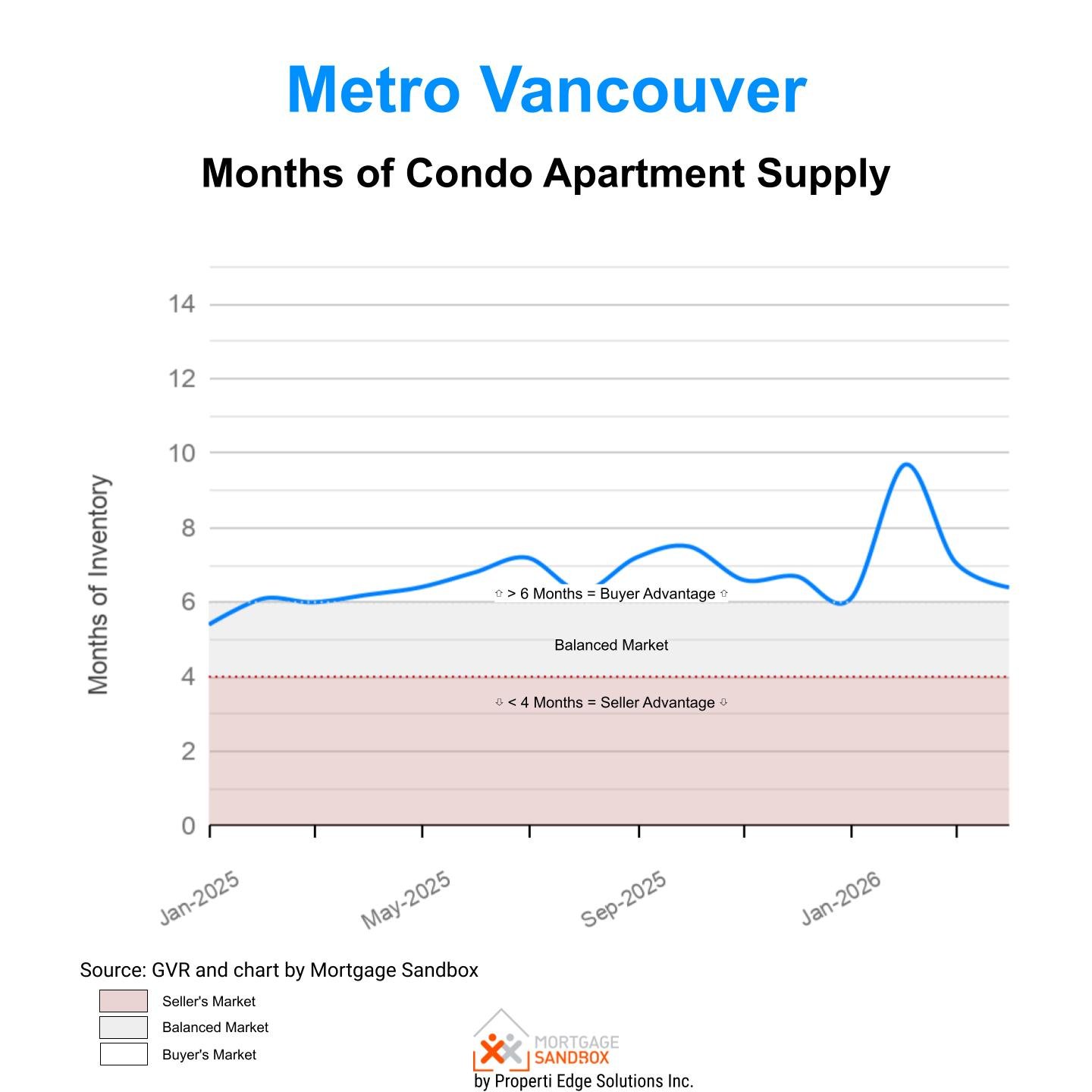
The condo apartment market has 6.4 months of inventory in March 2026. Last year at this time, it was 6.2 months. That is a very small increase, and it means inventory levels are relatively unchanged. With more than six months of supply, buyers continue to have the upper hand in negotiations.
Purchases and Active Listings
Purchase demand has dropped 8 percent compared to last year. Fewer people are buying condos. At the same time, the supply of active listings has also dropped, by 5 percent. Both sides of the market have cooled off. The drop in demand is a bit larger than the drop in supply, which keeps the market firmly in buyer’s territory.
Price Trends
The benchmark condo apartment price is now $706,700. Over the past year, that price has dropped 8 percent in favour of buyers. One year ago, the benchmark was $767,300. That is a decrease of about $60,600. Over the past three months, the price has remained flat. No further drop, but no increase either. Stability can be a welcome sign for both buyers and sellers, but it does not signal a rebound yet.
Risks to Watch in Metro Vancouver’s Housing Market
Several risks could affect the market in the coming months and years. Some are local, some are national, and some come from global events.
Macro Risks: Market Size and Interest Rates
Market Size
Metro Vancouver is a large property market with a deep pool of potential buyers. That means even in a slow market, sellers can usually find someone to buy their home. This large buyer base can prevent prices from falling too sharply.
Interest Rates Cycle
Over the last few years, interest rates have been declining, and economists believe they are currently at the low end of the cycle. This suggests that, given the current economic conditions, rates are likely to start rising in late 2026 or early 2027.
Lower interest rates enhance buyers' purchasing power, typically stimulating the housing market. Consequently, the rate environment was generally favourable for the market heading into 2026.
Geopolitical Risks: Iran Conflict and Mortgage Rates
The conflict involving Iran has increased oil prices and could bring a return to high inflation. The Bank of Canada, faced with higher inflation, has an obligation to raise rates to combat inflation.
The effect is that five-year fixed mortgage rates in Canada have gone up by about 0.1 to 0.25 percent. Before this conflict, most economists expected rates to start rising in late 2026 or early 2027. But higher oil prices and inflationary pressures from the war have changed that outlook. Investors now expect rate increases to come earlier in 2026.
Higher mortgage rates reduce home buyer budgets. If rates continue to climb, they will act like “ice cold water” on market demand. Even a small increase in rates can price some buyers out of the market or force them to wait for lower and more affordable prices.
WARNING: The high oil prices and inflation resulting from the war in Iran could be quickly reversed if the U.S. ends the conflict and oil prices decline. The war has created significant uncertainty, and any economist making forecasts has had to make assumptions about the long-term implications of the conflict and incorporate them into their predictions. Unfortunately, neither Iran nor the U.S. has been very predictable, so most assumptions may be directionally helpful but are likely to be incorrect.
Detached House Market Risks
Market Balance
With more than six months of inventory, the detached market is a buyer’s market. And months of inventory are consistent with last year. So the balance has not changed dramatically, even though prices have dropped.Prices have not fallen sufficiently to generate enough demand to balance the market.
Price Fundamentals
Prices have been moderately volatile. More importantly, prices are disconnected from local incomes. There is still a clear bubble risk. The benchmark detached house price is 20.6 times the local median household income. For comparison, a ratio of four to six times income is considered more sustainable. That means the average family would need more than 20 years of their full tax-free household income to buy a typical detached house. This is a major red flag.
New Housing Supply
Construction levels are typical for Metro Vancouver. The market can likely absorb completed units without a big impact on prices. That means new supply is not the main problem right now; affordability is.
Looking at the bigger picture, detached house construction in Surrey and Coquitlam is counterbalanced by land assemblies closer to major centers where houses are being torn down and replaced by apartments and townhomes. Net housing stock of detached houses is flat or shrinking.
Condo Apartment Market Risks
Market Balance
With more than six months of inventory, the condo market is also a buyer’s market. Months of inventory are consistent with last year. No major shift in supply and demand balance.
Price Fundamentals
Prices have been stable recently, but they are still high when you consider local incomes. Many condo properties could be overvalued. The benchmark condo price is 7.9 times the local median household income. The sustainable range is four to six times income. So condos are also overpriced compared to what local families can afford, though not as extreme as detached houses.
New Housing Supply
Vancouver has typical construction levels. However, buyers are unwilling to pay a high premium for new construction when there is ample choice in the resale market.
Here is a real example from March 2026: On the Cambie corridor, developers are marketing new projects at $1,200 per square foot. Meanwhile, five-year-old units nearby, which are move-in ready, are listed at $1,000 per square foot. That's a difference of more than 20 percent. Why would a buyer pay a premium and take the risk of purchasing a property off the blueprint, especially when there’s a possibility that the project might be canceled before completion? They could instead choose to buy a unit in the same neighborhood, get a 20 percent discount, know exactly what they're getting, and move in by May.
There is plenty of latent demand in the Vancouver market. Latent demand means people want to buy but are waiting for the affordability or better market conditions. But developers need to adjust their pricing to current market conditions. With resale market supply trending upward, the market will become less favourable for developers over the next two years. A recovery may arrive in 2028, but that could be after two years of flat or falling prices. The starting price point in that future market could be much lower than today’s market value.
What This Means for Buyers and Sellers
For buyers, April 2026 continues to offer negotiating power in both market segments. Detached house prices have dropped significantly over the past year, and condo prices have also fallen. Low interest rates are helping with affordability, but the recent rise in fixed mortgage rates is a warning sign. Buyers should act carefully and consider that prices could fall further, especially for detached homes where the bubble risk is highest.
For sellers, the market is challenging but not impossible. Detached home sellers are seeing a small improvement in conditions as inventory drops and demand rises. Condo sellers face weaker demand and plenty of competition from resale units. Pricing realistically is essential. Overpricing a home in a buyer’s market usually leads to longer time-on-market and eventual price cuts.
For developers, the message is clear. Adjust pricing to match resale market realities. The Cambie corridor example shows that new construction cannot command a large premium right now. With two more years of tough conditions possible, waiting for a 2028 recovery may mean accepting much lower prices than today.
Conclusion
Metro Vancouver’s housing market in April 2026 is defined by buyer’s conditions, falling or flat prices, and growing risks from global conflicts and local affordability problems. Detached houses are seeing some improvement in demand, but prices remain far from sustainable levels. Condos are stable but overvalued compared to incomes. The Iran conflict has already pushed up mortgage rates earlier than expected, and that could cool demand further.
Buyers have the upper hand for now, but they should watch interest rate trends closely. Sellers and developers need to be realistic about pricing. The next 18 months will show whether mortagage rates are low enough to eventually lift the market, or whether high prices and rising mortgage costs will keep Metro Vancouver in a buyer’s market though to the end of 2027.