
Metro Victoria
Real Estate Trends and Price Forecast

HIGHLIGHTS
Metro Victoria home values have been volatile since 2021. Recent data shows diverging trends across property types.
Detached and townhouse markets are currently seller's markets, giving sellers the upper hand in negotiations. Apartment conditions are balanced, with equal negotiating power between buyers and sellers.
While industry experts saw signs of improvement in late 2024, conditions have shifted through 2025 and remain uncertain as we look toward 2027 and 2028.
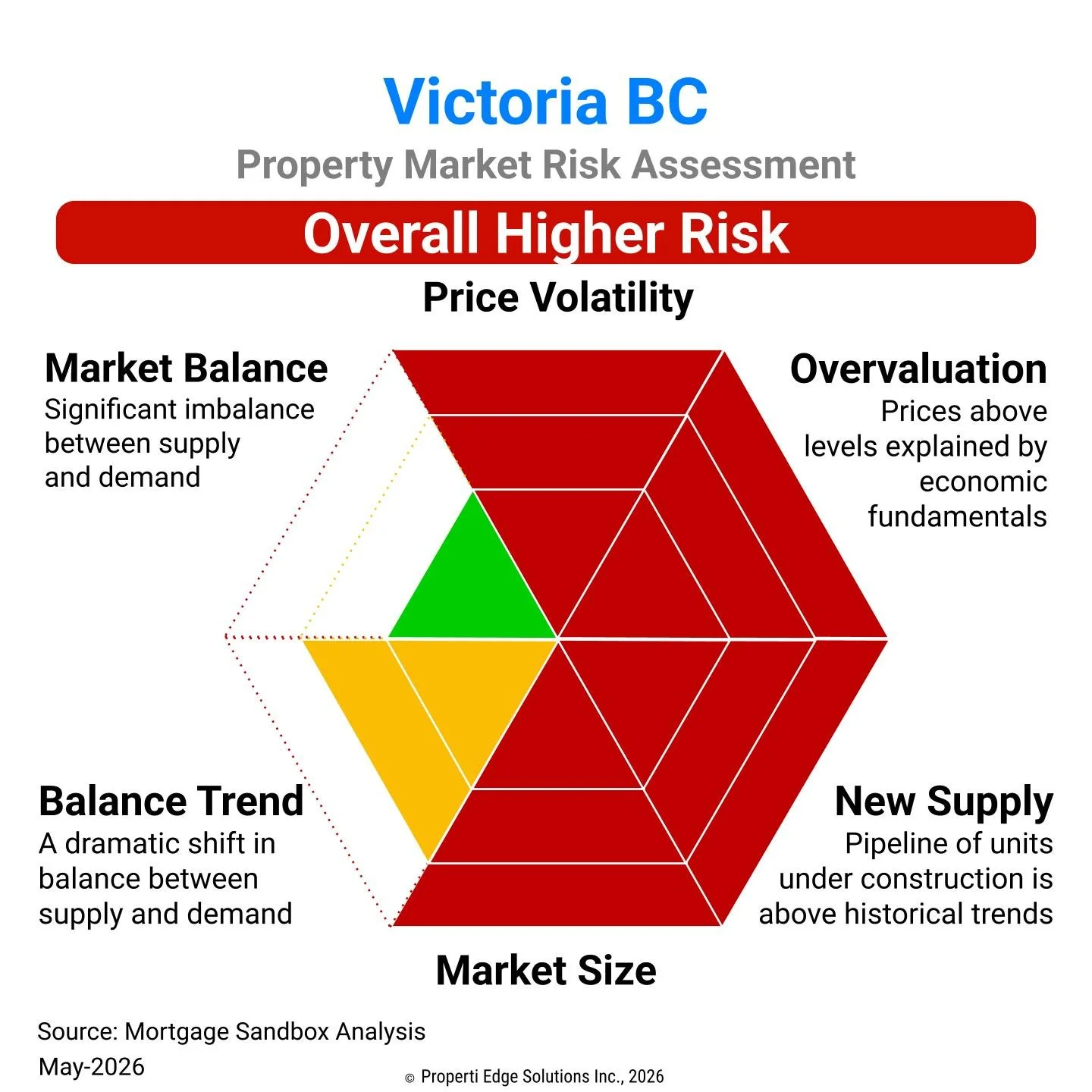
Multi-factor analysis identifies Metro Victoria as a higher-risk real estate market.
Mortgage rates have eased from their peak but remain elevated relative to the 2010–2020 average, limiting buyer budgets.
Economic uncertainty persists due to shifting immigration policies, trade wars, the war in Iran, and fluctuations in interest rates. All factors that influence future market dynamics.
This article covers:
What is the state of the Victoria property market?
Where are Victoria's prices headed?
Should investors sell?
Is this a good time to buy?
1. What is the state of the Victoria property market?
Overview of the Victoria Property Market
Metro Victoria is a region of 435 thousand people that is renowned for its mild weather and historical charm.
Victoria, BC, offers a distinct charm that draws people in, especially retirees. Here's a breakdown of why Victoria is attractive:
Charming and Historic Atmosphere: Victoria boasts a distinctly British feel, with beautiful Victorian architecture, manicured gardens, and a slower pace of life. This creates a quaint and elegant atmosphere that many find appealing. Its historical significance as one of the oldest cities in the Pacific Northwest adds to its character.
Mild Climate: Victoria enjoys a mild climate, with less extreme temperatures and few heavy snowfalls. This makes it particularly attractive to those seeking a comfortable year-round environment, especially retirees.
Beautiful Gardens and Green Spaces: Victoria is known as the "City of Gardens," with world-renowned attractions like Butchart Gardens. The city is filled with parks, green spaces, and meticulously maintained flowerbeds, creating a visually stunning environment.
Waterfront Lifestyle: Situated on the southern tip of Vancouver Island, Victoria offers easy access to the ocean. The Inner Harbour is a vibrant hub with boat tours, whale watching, and scenic walkways.
Cultural and Recreational Activities: The city offers a rich cultural scene with museums, art galleries, theaters, and festivals. Outdoor activities are abundant, including hiking, cycling, kayaking, and golfing.
Slower Pace of Life: Compared to Vancouver, Victoria offers a more relaxed and laid-back lifestyle. This is a significant draw for retirees seeking a peaceful and tranquil environment.
Retirement Haven: The combination of mild climate, beautiful scenery, access to healthcare, and a slower pace of life makes Victoria a highly desirable retirement destination. It is a very safe city, which is also a huge draw for retirees.
Capital City: As the capital of British Columbia, Victoria is home to the provincial legislature buildings, adding a sense of civic importance and providing access to government services and cultural events. This also provides many stable jobs.
Victoria remains an expensive city to live in, particularly when it comes to housing. Overall, Victoria offers a high quality of life, a vibrant culture, and a strong economy.
Supply levels are now above those seen a year ago, though the degree varies by property type. Buyers and sellers should expect a market with more choice for buyers than in 2025, but conditions remain competitive for sellers in detached and townhouse segments.

Metro Victoria Detached House Market Conditions
The detached house market is a seller's market, meaning sellers hold the upper hand in negotiations. Inventory levels have improved modestly in favour of buyers, with months of inventory edging higher compared to last year.
Purchase demand has eased compared to a year ago, while the supply of active listings has remained relatively stable. Over the past three months, benchmark and median prices have both moved in favour of sellers. However, looking back over the full twelve months, the benchmark detached price has shifted in favour of buyers.
Demand in Metro Victoria remains constrained by affordability. Although many people desire to buy a home, high borrowing costs continue to limit successful purchases. New homebuyers struggle to enter the market, and many current homeowners cannot qualify for a new mortgage under today's stress-testing requirements to upgrade to a larger home.
On the other hand, the total number of active listings is trending upward, giving buyers more options than a year ago.
Metro Victoria New Construction Home Prices
Prices of new homes have levelled off and are moving sideways. With this plateau at elevated levels and construction activity remaining high, some homebuyers may find that earlier purchasers in their development paid more than recent buyers.
The new construction market continues to face challenges nationally. With media stories of pre-sales buyers facing financial hardship, some Victoria pre-sale buyers may get cold feet. Based on economic fundamentals and shifting buyer sentiment, prices for new products could soften in 2026.
Does this concern you? Read the Pros and Cons of Buying Pre-sale Homes
Much higher than normal construction levels persist, and market absorption challenges are likely. Developers may increasingly respond by offering price incentives or bonus amenities to encourage buyers, particularly in projects where sales momentum slows.
Market Risk
Based on Mortgage Sandbox analysis, Victoria remains at moderate to higher risk of a significant market correction.
Rising resale inventory in some segments, stretched affordability, and elevated construction activity all contribute to this heightened risk profile as we look out to 2027 and 2028.

Our platform matches you with local, pre-screened, values-aligned Realtors.
Shared values make better working relationships.
Metro Victoria Condo Apartment Market Conditions
The apartment market is a balanced market, meaning buyers and sellers have equal negotiating power. Inventory levels have improved significantly in favour of buyers, with months of inventory rising considerably compared to last year.
Purchase demand has dropped sharply, while the supply of active listings has increased. Over the past three months, the benchmark apartment price has moved in favour of sellers, but the median price has shifted in favour of buyers. Over the full twelve months, the benchmark condo price has moved in favour of buyers.
Metro Victoria Townhouse Market Conditions
The townhouse market remains a seller's market, giving sellers the upper hand in negotiations. However, inventory levels have improved notably in favour of buyers, with months of inventory rising compared to last year.
Purchase demand has increased, and the supply of active listings has surged even more significantly, leaving buyers with more options and greater leverage on terms and conditions.
Over the past three months, the benchmark townhouse price has moved slightly in favour of sellers, while the median price has shifted in favour of buyers. Looking back twelve months, the benchmark townhouse price has moved in favour of buyers.
Still a challenge for first-time homebuyers
Metro Victoria's home prices are not very affordable. A homebuyer household earning a typical median before-tax income can only qualify for a modest mortgage. To purchase a benchmark priced condo, a buyer would need to save a substantial down payment or receive a large gift from family. For most people, that is just not possible.

What about the rest of BC?
Read the Vancouver Home Price Forecast and Okanagan Home Price Forecast.
2. Where are Metro Victoria home prices headed?
There is significant uncertainty in the forecasts for 2027 and 2028. Recent trends indicate softening demand in some segments, rising inventory levels, and mixed price movements. Detached and townhouse prices have seen short-term increases but long-term declines. Apartment prices show a similar pattern. Potential price increases over the next few years may be limited unless there is a substantial change in underlying fundamentals.
Our 5-Factor Analysis
We assess five forces that help explain why several forecasters are anticipating softer price performance or potential price drops: Core Demand, Non-Core Demand, Supply, Government Interventions, and Consumer Sentiment.
How do we arrive at our forecast range?
Key External Variables
Outside the 5-factor model, there are external factors that could have a knock-on effect on the market. These include:
Will the war in Iran lead to higher mortgage rates, as the Bank of Canada is forced to combat inflation caused by higher gas prices?
As a result of the federal government's immigration policy pivot, how much lower will population growth be compared to recent years?
Will mortgage rates reset at a new normal range that is higher than Canadians have grown used to, or will they return to pre-pandemic levels?
Will Canada's trade dispute with the U.S. lead to weaker economic growth or a recession that would further pressure housing demand and prices?
⇓ Continued Below ⇓

Need a Realtor?
We match you with local, pre-screened, values-aligned Realtors and Mortgage Brokers.
Methodolgy
At Mortgage Sandbox, we provide a price range rather than attempting a single prediction because many real estate risks can impact prices. Risks are events that may or may not happen. As a result, we review various forecasts from leading lenders and real estate firms. We then present the most optimistic estimates, the most pessimistic prediction, and the average forecast.
Would you like to learn more about real estate risk? We've written a comprehensive report explaining the uncertainty level in the Canadian real estate market.
Our forecast inputs:

Get a mortgage broker to pre-approve you
Realtors want you to be pre-approved before you look at homes
3. Is it a good time to sell a home in Victoria?
Annual Real Estate Cycle
The annual real estate cycle usually favours sellers in the first half of the year, and this seasonal pattern remains relevant in the current environment.
Current Strategies
From a seller's perspective, structural and macro changes continue to influence prices. The detached and townhouse markets currently favour sellers, while the apartment market is balanced. This year may still be a better time to sell than in a few years' time, particularly for detached properties. Remember that the three market segments are on different trajectories, with detached and townhouses relatively stronger and apartments under more downward pressure over the longer term.
Professional Advice
Our analysis is at the macro, birds-eye level. There are nuances at the neighbourhood level, depending on the property type and condition.
Sellers should always consult a mortgage broker early to prioritize flexible loan conditions and reduce the risk of mortgage cancellation penalties. Also, consult more than one real estate agent. Sometimes agents will tell you what you want to hear so they can win the listing and then lower your expectations once you are bound to the contract. You will want a realistic assessment of what cosmetic changes need to be made to lift the perceived property value, what recent properties like yours have sold for, and where the market is trending.
Planning to Sell? Check out our Complete Home Seller’s Guide.

Fixed or Variable rate mortgage?
Find out where mortgage rates are headed before you start to negotiate.
4. Is this a good time to buy a Victoria property?
Annual Real Estate Cycle
The annual real estate cycle usually favours buyers in late summer and autumn, and this pattern is expected to persist into 2027 and 2028.
Current Strategies
Price trends are mixed: detached and townhouse benchmarks have seen short-term increases, while year-over-year changes have favoured buyers across all segments. Supply is rising across all property types, giving buyers more options.
These factors would lead many buyers to conclude that later in 2027 or even 2028 could offer more favourable entry points, particularly if inventory continues to accumulate and sellers grow more motivated.
However, while mortgage rates are easing, they still feel high to most buyers, and there is no guarantee that borrowing costs will fall back to prior lows. It is almost impossible to time the market perfectly.
If you are buying your forever home and do not plan to sell for a decade or more, the risks of buying now are lower than they were when prices and rates were both surging.
If you are considering buying, be sure to drive a hard bargain and pay as close to market value as possible. Also, do not bite off more than you can chew when it comes to financing, especially in a market where prices could remain flat or soften further.
Professional Advice
Buyers should always consult a mortgage broker early in the process to obtain a pre-approval. Although current interest rates are easing, they are expected to rise within the next 9 to 18 months. With pre-approval, you can lock in a rate for 4 months before closing, helping mitigate financial risk.
Additionally, it is wise to consult more than one real estate agent. You need someone who will work with you on your terms. Buyer agents can increase their commission income by encouraging you to spend more or transact more quickly. Their earnings are tied to total annual transaction volume, so they earn the same commission regardless of how much time they spend helping you find a home that meets your needs and has strong long-term investment potential.
Planning to Buy? Check out our Complete Home Buyer’s Guide so we can walk you through the end-to-end process and get you ready to buy your new home!

How much home can you afford?
Our mortgage calculator takes uses up-to-date mortgage rates and calculates the price of a home you could afford.
Here are some recent headlines you might be interested in:
Toronto and Vancouver housing bubble risk eases, UBS index finds (Wealth Professional | Sep 25)
Bank of Canada's Macklem flags risk of delaying rate hike too long (Bloomberg | Sep 21)
CMHC expects housing starts slowdown to continue toward year-end (REM | Sep 16)
Victoria home sales climb by 12.6% in August (Victoria News | Sep 04)How worried should variable-rate borrowers be about Bank of Canada rate hikes? (Financial Post | Sep 04)
Canada's fixed mortgage rates surge higher as bond yields continue to rise (Toronto Star | Sep 03)
How immigration changes are contributing to B.C.'s housing market slowdown (CBC News | Sep 01)
B.C. judge rules $30.5M in Burnaby condo pre-sales 'unenforceable' (Business in Vancouver | Aug 26)
Home sales, prices declining in 2026 amid weaker market activity (CityNews Ottawa | Jul 22)
Like this report? Like us on Facebook.